
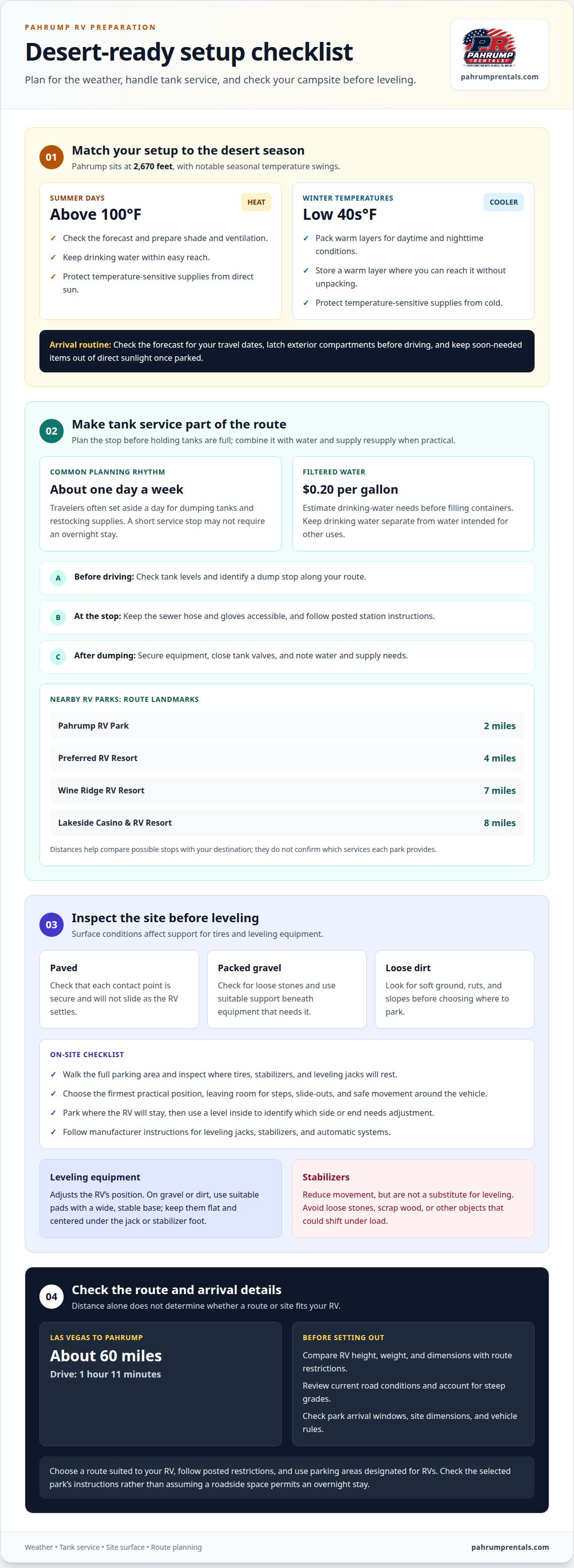
Preparing an RV for Pahrump means planning for desert temperatures, tank service, and a level campsite. Summer days regularly exceed 100°F, while winter temperatures can drop to the low 40s; Pahrump sits at 2,670 feet.
Heat, water use, and uneven ground can all affect how comfortably your RV is set up, so planning ahead helps. This guide explains how to prepare an RV for a trip to Pahrump, including desert conditions, dump-station fees, and leveling on different surfaces. You’ll also find practical tips for organizing supplies and arriving ready for your stay.
Key Takeaways
- Plan tank dumping and water resupply as part of your route so these stops fit smoothly into travel days.
- Match clothing, ventilation, and other preparations to desert conditions and the season of your visit.
- Assess the campsite surface before leveling, then use suitable leveling equipment for a stable setup.
- Inspect key RV systems before departure and pack supplies that support routine maintenance and desert travel.
- Use tool rentals and professional hardware solutions for practical project or equipment needs connected to your RV preparations.
Dump stations and dump fees
Plan tank service around your route, before the holding tanks are full. Travelers often set aside about one day a week to dump tanks and restock RV supplies. That can make a short service stop possible without an overnight stay.
Use the stop to handle related supplies efficiently. Travelers often combine tank dumping with water refills and other resupply tasks. Filtered water stations cost $.20 per gallon, so estimate how much drinking water you need before filling containers. Some travelers refill three water jugs with reverse-osmosis water. Keep drinking water separate from water intended for other uses.
Nearby parks provide useful route landmarks. Lakeside Casino & RV Resort is 8 miles from Pahrump. Preferred RV Resort is 4 miles away, Wine Ridge RV Resort is 7 miles away, and Pahrump RV Park is 2 miles away. These distances help you compare possible stops with your planned destination. They don’t establish which services each park provides.
- Before driving: Check tank levels and identify a dump stop along your route.
- At the stop: Keep the sewer hose and gloves accessible, and follow the station’s posted instructions.
- After dumping: Secure equipment, close tank valves, and note water and supply needs.
Schedule resupply for a travel day or the day before. If you’re resupplying on the road, keep that day’s drive short. An RV park may bring showers, laundry, propane, tank dumping, and water refills together in one stop. When leaving a full-hookup park for dry camping, prepare food beforehand to conserve water and gray-tank capacity.
For Nevada driving, towing, and parking, secure the trailer and load before departure. Follow posted restrictions and use parking areas designated for RVs. At each stop, follow the site’s instructions rather than assuming a roadside space permits an overnight stay.
For dump stations, potable water, propane, and fuel, plan around RV parks and resupply stops in the Pahrump area. Local parks are useful for tank service and may offer access to other resupply needs. Filtered water stations provide drinking-water refills for $.20 per gallon. Fit each stop to the supplies you need, then leave enough time for the tank and hose steps before getting back on the road.
Pahrump’s desert climate and elevation
Pahrump sits at 2,670 feet, so prepare for desert conditions. Summer days regularly exceed 100°F, while winter temperatures can drop to the low 40s. Those seasonal swings affect comfort inside a parked RV and during travel. Before departure, check the forecast for your travel dates and plan clothing for daytime and nighttime conditions. Store temperature-sensitive supplies where they’ll be protected from direct sun or cold. At camp, use available shade and ventilation to manage heat inside the vehicle.
To understand how to prepare an RV for a trip to Pahrump, plan your arrival routine around the forecast. In summer, ventilate the RV before settling inside and keep drinking water within easy reach. In winter, store warm layers where you can reach them without unpacking. Before driving, make sure exterior compartments are latched. Once parked, keep items you’ll need soon out of direct sunlight.
Reservations, check-in times, and vehicle rules vary by RV park. Plan around your chosen park’s arrival window, site dimensions, and rules for extra vehicles or trailers.
Pahrump is about 60 miles west of Las Vegas, and the drive takes 1 hour 11 minutes. Choose a route suited to your RV, then review current road conditions before leaving. Allow time to adjust plans if weather or roadwork affects your selected route.
RV access near Pahrump depends on your rig’s height, weight, and route. Compare your vehicle’s dimensions with posted clearance and weight restrictions, and account for steep grades when choosing roads. Don’t assume a route is suitable based on distance alone: even a short route may have constraints that matter for a larger vehicle.
RV parks around Pahrump offer overnight stays, with rates and hookups varying by park and site. Compare the site’s connections with your RV’s needs, including whether you want full hookups or a simpler stay. Include arrival instructions and vehicle limits in your reservation planning.
A practical way to prepare an RV for a trip to Pahrump is to match your setup to the season and campsite:
- For summer: Check forecast temperatures above 100°F and prepare shade, ventilation, and accessible water.
- For winter: Pack layers for temperatures that can fall to the low 40s.
- Before driving: Compare your RV’s dimensions with route restrictions and park site conditions.
- On arrival: Follow the park’s check-in instructions and position the RV for safe access.
RV site surfaces and leveling
At a Pahrump campsite, assess the pad before positioning your RV. Paved sites, packed gravel, and loose dirt provide different support for tires and leveling equipment. Walk the parking area and look for soft spots, ruts, loose stones, and noticeable slopes. Check the full space, including where stabilizers or leveling jacks will rest. Choose the firmest practical position, leaving room for steps, slide-outs, and safe movement around the vehicle.
Once you’ve chosen a position, park the RV where it will stay before leveling. Use a level inside to identify which side or end needs adjustment. Follow the manufacturer’s instructions for leveling jacks, stabilizers, and any automatic system. These components serve different purposes: stabilizers reduce movement, while leveling equipment adjusts the RV’s position. Don’t use stabilizers as a substitute for leveling.
On gravel or dirt, place suitable leveling pads beneath equipment that needs support. A wide, stable base helps distribute contact across the surface. Keep pads flat and centered under the jack or stabilizer foot. Avoid stacking loose stones, scrap wood, or objects that could shift under load. On pavement, check that each contact point is secure and won’t slide as the RV settles.
- Inspect the pad: Identify slope, ruts, loose material, and soft ground before moving into place.
- Position the RV: Leave clearance for slide-outs, doors, steps, and hookups.
- Level the vehicle: Use the onboard level and follow the equipment instructions.
- Set the supports: Use stable pads where needed, then recheck the RV’s position.
Recheck the setup after parking. Open the refrigerator door and see whether it swings as expected, then check interior doors and walking areas. If the RV feels tilted or a support shifts, stop and reassess. Small adjustments are easier before connecting utilities or unpacking. Keep leveling equipment accessible for departure, and remove pads only when the RV is ready to move.
Site conditions can vary within a campground. A gravel pad may have a compacted center and softer edges; a paved area may slope toward drainage. Use the surface beneath your RV to guide placement rather than relying on the campsite description alone. A careful inspection, correct equipment use, and final level check help create a steady setup for your stay.
What should I inspect and service on an RV before a road trip?
Before driving toward Pahrump, walk around the RV and check the interior. Start with the tires: inspect tread, sidewalls, and visible damage, then set pressure according to the RV or tire manufacturer’s guidance. Check the spare, too. Look for bulges, cracks, or objects lodged in the tread. Address any visible damage before loading up for travel.
Next, inspect the towing and braking systems. Confirm the hitch is secure and the safety chains are connected correctly. Check that the trailer lights respond to the tow vehicle’s signals, including brake lights and turn signals. Test the RV’s brakes according to the manufacturer’s recommended procedure. Listen for unusual sounds during a short, controlled test. Secure loose cargo so it cannot shift while braking or turning.
Under the hood, inspect the engine oil, coolant, and other fluids listed in the owner’s manual. Look for leaks beneath the vehicle and visible wear on hoses. Confirm the battery connections are secure and the windshield washer system works. Review the service schedule for maintenance due before departure. Keep service records accessible, especially if a repair or part replacement affects travel readiness.
- Exterior: Check mirrors, lights, wipers, doors, roof edges, and storage compartment latches.
- Cabin: Test seat belts, dashboard alerts, ventilation, and essential controls.
- Water systems: Inspect visible plumbing connections, faucets, and drains for leaks.
- Appliances: Test the refrigerator, water heater, and cooking equipment according to their manuals.
Check the roof and exterior seals for visible gaps, lifting, or cracks. Close windows and vents before departure, then make sure exterior compartments latch securely. Inside, stow breakable items and secure drawers, cabinet doors, and movable equipment. A final walk-through can catch an open compartment or loose item before it becomes a distraction on the road.
Finish with a brief systems check while parked. Start the engine, confirm dashboard indicators behave as expected, and test the lights again. If the RV has a generator or other onboard equipment, follow its manual for inspection and operation. Note any unusual noise, odor, warning light, or leak, and address it before the trip. A written checklist makes it easier to repeat the inspection before future drives.
Keep the owner’s manual and roadside equipment in an accessible compartment. Tailor inspection steps to the RV’s type, age, and recent service history. A motorhome and a towable trailer have different connection points, but both need sound tires, working lights, secure cargo, and reliable braking before leaving for Pahrump.
What RV supplies and emergency gear should I pack for a desert trip?
Pack for the time between stops as well as your campground stay. For a Pahrump trip, keep drinking water, sun protection, and basic repair items easy to reach. Store frequently used supplies inside the RV, not beneath tightly packed cargo. Group emergency items together so you can find them without unpacking clothing, food, or campsite equipment.
Build a travel kit around your RV and route. Include a first-aid kit, flashlight, spare batteries, portable phone charger, and paper map. Add work gloves, a tire pressure gauge, and tools for routine adjustments on your vehicle. Keep the owner’s manual with the tools so equipment instructions are available if an issue arises.
- For sun and heat: Pack a brimmed hat, sunglasses, sunscreen, and lightweight clothing.
- For roadside stops: Keep reflective warning equipment, a flashlight, and drinking water accessible.
- For minor repairs: Bring gloves, basic hand tools, and supplies suited to your RV.
- For communication: Carry charging cables, a portable charger, and a paper route map.
Separate supplies by purpose. Put roadside gear near an exterior compartment you can reach safely while parked. Store personal items, such as a hat and sunglasses, near the entrance. Secure food and water for travel, and place heavier items low to limit shifting. Before leaving, check that items in each storage compartment won’t move when the RV turns or stops.
Plan water around your activities and route. Keep drinking water separate from water used for cleaning, and refill containers at planned resupply stops. Travelers who use reverse-osmosis water may carry separate drinking-water jugs. Pack reusable bottles where passengers can reach them without entering storage compartments or blocking the driver.
Choose tools for your RV’s actual setup. A motorhome, towable trailer, and fifth wheel may need different connection or adjustment tools. Review the owner’s manual, then remove equipment that doesn’t fit your vehicle. Check flashlight and charger batteries before departure, and return each item to the same labeled storage place after use.
Before each travel day, check drinking water, phone power, sun protection, first-aid supplies, and roadside gear. Replenish items used during the previous drive. Pahrump Rentals & Hardware carries RV supplies to help you prepare for your vehicle and planned stay.
Pahrump Rentals & Hardware: Industrial Equipment Rentals
Pahrump Rentals & Hardware offers industrial equipment rentals for projects that call for rented equipment. If your RV preparation involves work around a campsite or another practical task, tool rentals and professional hardware solutions can help you source the equipment and materials you need. Contractors can also use the Contractor Portal to manage their work.
Choose the offering that matches the task. Renting can suit equipment you need temporarily, while hardware solutions provide project materials. Planning ahead helps you identify what the work requires. These services complement trip preparation when your plans involve more than packing and vehicle checks.
For equipment rentals, hardware, or RV supplies in Pahrump, contact Pahrump Rentals & Hardware to discuss your needs.
Make Your Pahrump Trip Plan Ready to Go
A smoother departure starts with turning your preparation notes into a practical plan. Before traveling, list the tasks that need attention, the equipment you’ll use, and the supplies you want within reach. Separate essential preparations from optional upgrades so you can focus first on a road-ready RV and a suitable campsite setup.
Knowing how to prepare an RV for a trip to Pahrump also means matching your next steps to your vehicle and plans. A towable trailer may need different equipment checks than a motorhome, and a short stay may call for a different packing approach than a longer visit. Use your RV manual to guide maintenance, and keep your preparation list handy for future trips.
For project equipment, hardware, or tool needs connected to your plans, reach out to Pahrump Rentals & Hardware. Contact Pahrump Rentals & Hardware to discuss the right next step for your needs. With a clear plan and the right preparation, you can set out for Pahrump feeling organized and ready for the road.
Frequently Asked Questions
What is the weather in Pahrump by season, and how should I prepare an RV for desert heat?
Summer calls for heat-aware travel planning, while winter requires warm layers. For spring and fall, check a forecast for your specific travel dates. In summer, park before the hottest part of the day when practical, close blinds on sun-facing windows, and keep ventilation pathways clear. Store heat-sensitive items out of direct sunlight. Before each drive, review the forecast and adjust outdoor activities or departure timing to suit conditions.
What desert hazards near Pahrump should RV travelers prepare for, including heat, wind, and flash floods?
Be ready to adapt your route and campsite plans if heat, wind, or flooding affects travel. Check weather and road alerts before setting out, secure awnings and loose outdoor gear, and keep an alternate route in mind. If water is crossing a roadway, don’t drive through it. Pause and choose another route or wait until conditions allow you to continue safely.
What are Nevada RV driving, towing, and parking laws travelers should know?
Before departure, secure the trailer and its load, follow posted restrictions, and use parking areas designated for RVs. Compare your RV’s height and weight with route restrictions, and follow the parking instructions at each site.


