

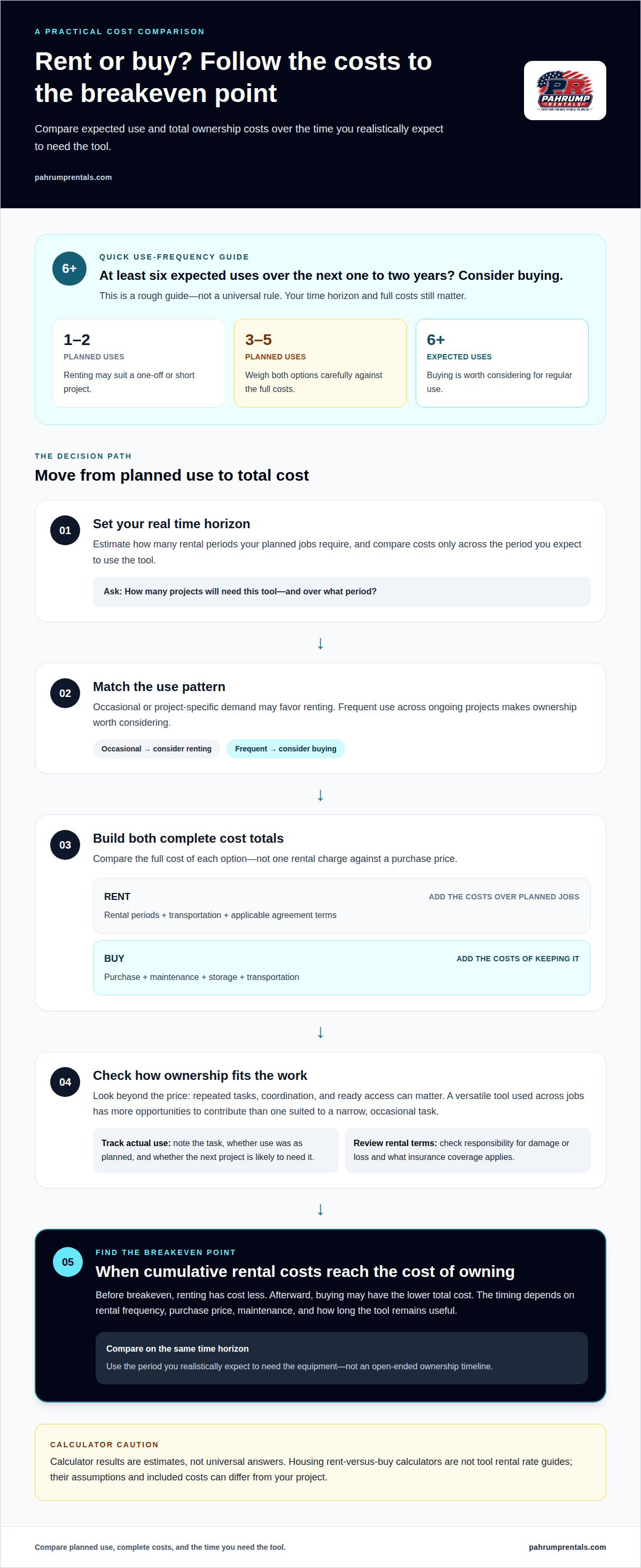
Renting can cost more than buying when you use a tool regularly. As a rough guide, consider buying if you expect to use it at least six times over the next one to two years, renting for one or two planned uses, and weighing both options carefully at three to five uses. The cost savings of renting tools vs. buying depend on how often you use the tool and how long you need it.
Avoiding a large purchase for a one-off project makes sense, but repeated rental costs can add up. This guide explains how use, time horizon, maintenance, storage, and transportation affect the decision, and how to read calculator estimates without treating them as universal answers. You’ll have a straightforward way to compare renting and buying for your next project.
Key Takeaways
- Compare total costs over the period you expect to use a tool, including purchase, repeat rentals, maintenance, storage, and transportation.
- Frequent use over a longer period can make buying more economical, while a short project may favor renting.
- Treat calculator results as estimates: assumptions about upkeep, rental terms, and travel can change the comparison.
- Consider whether access to professionally maintained rental tools and avoiding long-term storage would simplify your project.
- Use Pahrump Rentals & Hardware’s tool rentals for project-based needs, with industrial equipment rentals and professional hardware solutions also available.
Buying VS Renting Tools: What’s The Best Option?
Compare the full cost of each option over the period you expect to use the tool. Renting may suit a short project or occasional use; buying may cost less over time if you use the tool regularly. Include rental or purchase charges, maintenance, storage, and transportation. The cost savings of renting tools versus buying depend on the tool, number of uses, and time horizon.
Estimate how many rental periods your planned jobs require, then compare that total with the purchase price and ongoing ownership costs. Include the time and cost of maintaining and storing an owned tool. A tool used across several projects may justify buying, while a specialized tool needed for one task may not. The breakeven point is when accumulated rental costs reach the combined cost of buying and keeping the tool.
Home calculators show how a chosen length of stay changes a rent-versus-buy comparison, but their figures are not tool rental rates. Homeownership costs can also include property taxes, homeowners insurance, and maintenance. These housing expenses illustrate why comparing only a monthly payment can hide the full cost.
Upfront housing costs differ too. Buying a home typically involves a down payment and closing costs; renting commonly involves a security deposit and first month’s rent, and may involve last month’s rent. These are calculator examples for housing, not estimates for tools. Inflation also affects a longer comparison: the calculator describes annual rent increases as typically 2-4% per year.
Consider opportunity cost alongside inflation. Money spent buying a tool is unavailable for another project or investment during that period. Renting preserves that capital, but repeated rental charges can accumulate. For homeowners, buying may build equity, while renting may leave more money available for other investments. The right comparison depends on planned use and the costs included.
There isn’t one typical U.S. purchase price for common power tools: costs vary by tool type, quality, and intended use. A rental quote also depends on the tool, rental period, and project needs; the exact figure is provided in a quote for your case.
Tool rental agreements may specify responsibility for damage or loss and explain insurance coverage. Review the terms before use, and document the tool’s condition so you understand what applies if damage occurs.
| Option | Best fit | Costs to compare |
|---|---|---|
| Rent | Occasional or project-specific use | Rental periods, transportation, and any applicable agreement terms |
| Buy | Frequent use across ongoing projects | Purchase, maintenance, storage, and transportation |
Choose by comparing expected uses with the full costs over your planned time horizon, not by weighing one rental charge against a purchase price.
Long-term savings from buying frequently used tools
Frequent use makes ownership worth considering, especially for a small tool used in routine work. The benefit isn’t limited to avoiding repeated rentals: keeping a familiar tool on hand can simplify planning when the same task comes up across different jobs. For a crew, that can mean making the equipment part of its regular workflow rather than arranging access each time.
Consider a team that regularly performs the same type of installation. If a particular tool is central to the task, owning it lets the team plan around equipment it knows. The tool can be assigned to the work, stored with related gear, and kept ready for the next scheduled job. Reliable access matters most when the work sequence is tight or several tasks depend on the same equipment.
Before deciding, assess how well the tool suits your actual work. A versatile tool used across different jobs has more opportunities to contribute than equipment designed for a narrow, occasional task. Consider, too, whether users know how to handle and care for it. A purchase is more useful when the equipment fits established work practices and has a clear role.
Track use across your jobs instead of relying on memory. A simple record can note which task required the tool, whether it was used as planned, and whether the next project is likely to need it. This helps distinguish recurring demand from a one-time spike. Consistent use may make ownership a better fit; irregular demand may favor waiting and staying flexible.
Buying can also simplify coordination when a project needs the same tool at different stages. Rather than scheduling access for each task, you can keep the equipment with the project setup. That benefit is strongest when the tool is used frequently and easy to keep ready. It matters less when the equipment would sit idle between isolated jobs.
Use this review to test whether ownership fits the way your work operates:
- Identify recurring tasks that rely on the same tool.
- Note whether access to the tool affects job sequencing or team coordination.
- Consider whether the tool serves several types of work or only a specialized task.
- Review actual use over time before committing funds that could support other needs.
A successful project can make owning a tool seem appealing, but one good experience doesn’t establish ongoing demand. Look for a consistent pattern in the work itself. When both repeated use and ready access matter, buying may serve the operation better over the long term.
Time horizon and breakeven point
A tool’s breakeven point is when cumulative rental costs equal the cost of owning it. Before then, renting has cost less; afterward, buying may have the lower total cost. The timing depends on rental frequency, purchase price, maintenance, and how long the tool remains useful. Calculate for the period you realistically expect to use the equipment, not an open-ended ownership timeline.
One displayed calculator example shows buying beginning to cost less than renting around year 9. That result is an illustration, not a universal tool-rental threshold. Those figures reflect that calculator’s assumptions, so they shouldn’t be treated as a forecast for a construction tool.
Compare costs for the same period. Estimate how often you’ll rent the tool, then add the charge for each rental period. Compare that total with the purchase expense and the costs of maintaining, storing, and transporting an owned tool. If circumstances change, for example, if a project is delayed or cancelled, update the expected rental periods before relying on your original breakeven estimate.
Use these steps to find when owning may become more economical:
- Choose the period your upcoming projects require the tool.
- Estimate rental periods using the expected job schedule.
- Add ownership expenses, including maintenance, storage, and movement between jobs.
- Compare both totals at the end of each planned period.
Rental costs can mount quickly when you rent a tool for long periods or repeated projects. A short, defined job may end before ownership costs are recovered. An ongoing need can shift the comparison toward buying, especially when the same equipment is needed regularly. The deciding factor is cumulative use, not whether a tool might be useful again someday.
Keep assumptions consistent. If the rental estimate includes transportation, include comparable transport costs for owning; if ownership includes maintenance, account for the time and expense involved. A calculator that omits a major cost can show a misleading breakeven date. Treat year 9 as an example from one displayed comparison, then use your own project schedule and relevant expenses to identify the likely turning point.
Calculator assumptions and limitations
A calculator is useful only when its assumptions match the equipment and project. Its result can change if it counts rental charges but leaves out transportation, maintenance, storage, or time spent arranging each rental. Before relying on a comparison, identify which expenses it includes and what else applies to your situation. One omitted cost can shift the estimated breakeven point.
Start with the work you expect to do. A practical first step is to identify two upcoming projects that would use the tool. If none come to mind, renting is generally a better choice than buying for an uncertain future need. This ties the decision to planned work rather than a broad guess about possible future use. Update the estimate if either project changes.
Next, consider equipment size and transportation. Moving large equipment can involve extra costs and effort. For example, if renting requires two trips across town, travel time may make buying more attractive. An hour each way on a weekend can affect the comparison, too. Include pickup and return trips in the rental cost instead of treating them as free.
Maintenance is another factor that can skew the result. Construction equipment needs regular maintenance, which takes time and may cost money. If staff lack the time or skills to maintain or repair equipment, account for that burden. Renting can provide access to tools maintained regularly by professionals, but rental terms may limit when and how often you can use them.
Some calculators also apply assumptions built for housing, not tools. One pre-filled home estimate sets aside 3% of a home’s value each year for repairs and maintenance. Another calculator describes annual rent increases as typically 2-4% per year. Those inputs do not establish tool-maintenance costs or tool-rental increases. Treat them as housing-model assumptions, not as figures to transfer into an equipment comparison.
Use a consistent method to assess the estimate:
- Match the calculator’s time period to your actual project schedule.
- Include transportation, maintenance, storage, and rental-use limits where they apply.
- Separate housing assumptions from tool expenses, including the 3% home-maintenance estimate.
- Recalculate when project plans, travel needs, or expected use change.
A calculator compares the inputs you provide; it can’t account for a changing job schedule or every practical constraint. A low rental total, for example, may overlook limits on use, while an ownership estimate may leave out regular upkeep. Treat the result as a structured estimate, then check each input against the projects, travel, and maintenance involved.
U.S. Power Tool Rental Rates: Daily, Weekly, Monthly
Daily, weekly, and monthly rental periods can match equipment access to a project schedule. There’s no single rate for every power tool. The rental amount depends on the equipment and how long you need it. Equipment rental rates generally represent a small proportion of equipment cost, but repeated rental periods still add up.
For a short task, a daily rental period may fit the planned work. For a longer project, compare the total cost across weekly or monthly periods. Don’t assume that a longer period automatically costs less overall. Calculate the total for your expected use, including days when work pauses but the rental continues. A project delay can change which period makes sense.
Common power tools serve different purposes, so compare equivalent options. A tool designed for drilling may not suit cutting or surface preparation. Identify the task, equipment type, and expected rental duration before comparing rates. This prevents a low rate for the wrong tool from distorting your budget.
| Rental period | Useful for | Comparison step |
|---|---|---|
| Daily | A defined task or brief work window | Count planned rental days and possible delays |
| Weekly | Work that spans several scheduled days | Compare the period total with separate daily periods |
| Monthly | Extended work with a longer equipment need | Compare the full period with shorter rental options |
Use the table as a budgeting framework, not a list of quoted rates. A daily estimate can understate the total if the project requires several rental periods. A monthly estimate may not suit a job that finishes early. Your quote depends on the tool, rental period, and project requirements, with the exact figure provided for your case.
Before choosing a rental period, map out the work schedule:
- List the tasks that require the power tool.
- Estimate when the tool is needed and when it can be returned.
- Allow for project pauses that could extend the rental period.
- Compare daily, weekly, and monthly totals for the same work plan.
This approach makes rental costs easier to compare with buying without mistaking a calculator’s assumptions for a local rate. For a project that needs equipment only temporarily, explore tool and equipment options that fit the work.
Pahrump Rentals & Hardware: Tool Rentals
Pahrump Rentals & Hardware offers tool rentals for projects where buying may not suit the expected use. Renting can work well for a specific job, occasional tasks, or equipment needed temporarily. For larger project needs, Industrial Equipment Rentals provide another option, while Professional Hardware Solutions support related work in Pahrump, Beatty, Goldfield, and Tonopah.
Consider the task, the equipment required, and how long you expect to use it. This context helps you choose a rental approach that fits your project instead of committing to equipment you may rarely use. Explore available tool and equipment options as you plan the work. Contractors can also use the Contractor Portal.
Contact Pahrump Rentals & Hardware to discuss your tool rental needs.
Plan Your Next Project With Confidence
Put your decision to work by outlining your next project and the equipment it requires. Whether you are prepping an outdoor entertainment space for a portable fire pit or tackling a routine home repair, a clear plan helps you apply the cost savings of renting tools versus buying to the job ahead instead of relying on a general rule. Adjust your approach as project needs change.
If you’d like to discuss your equipment needs, contact Pahrump Rentals & Hardware. A practical conversation can help you take the next step with confidence.
Frequently Asked Questions
How long should you stay before buying makes sense?
For a tool, the relevant timeframe is how long it remains useful for your work, not how long you stay in a home. Buying makes sense when planned work requires the same equipment throughout its useful life. A one-off job with no similar work scheduled gives ownership less time to prove its value. Consider whether future projects are already part of your workload.
How much maintenance is required?
Maintenance requirements vary by tool and manufacturer. Use the manual’s care instructions as your baseline, then keep a simple log of cleaning, inspections, and service. For example, note when you clean a tool after a dusty job and record visible wear before returning it to storage. This creates a clear upkeep record and helps catch maintenance tasks that might otherwise be missed.
Is renting always cheaper?
No. Renting isn’t automatically the lower-cost choice in every situation. It provides access for a defined period, while buying provides ongoing access. A frequently changing project schedule may favor short-term access; a steady workflow may benefit from having equipment ready between jobs. Compare the option that best fits how you’ll use the tool instead of assuming one method always costs less.
Rent or Buy Tools: When Does Buying Save Money?
Buying can save money when a tool has an ongoing role in your work and remains useful across future projects. A tool shared across tasks may offer more value than one dedicated to an unusual job. Availability matters, too: keeping essential equipment on hand helps teams plan their work sequence. Include the tool’s expected useful life in your decision, not just the first project.
How many times can you use a tool before buying is cheaper than renting it?
There’s no single number of uses that applies to every tool. The length of each use matters: several short tasks might fit within one rental period, while separate jobs could require separate rentals. Compare the rental periods your actual schedule creates with the tool’s useful life. This gives a more meaningful estimate than counting every time you switch the tool on.
What hidden costs of owning tools should be included, such as maintenance, repairs, storage, and batteries?
Account for costs beyond the tool itself, including upkeep, repairs, storage, and any batteries or charger your work requires. Consider consumable parts and time lost if equipment needs service during a scheduled job, too. For example, a tool without an organized storage space can be harder to find and keep ready. These details reveal the practical demands of ownership.
When is renting tools more cost-effective than buying them?
Renting suits specialized equipment that won’t have an ongoing role after a job. It can also help when a project needs extra tools at the same time, so work can proceed without keeping every unit afterward. Renting lets you use a tool before deciding whether it belongs in your regular equipment setup.
When is buying tools more cost-effective than renting them?
Buying suits equipment that supports routine work and needs to be available between scheduled jobs. It can also make sense for tools that serve several tasks rather than one narrow purpose. For example, a crew that regularly moves between related tasks can keep a familiar tool within its workflow. A clear storage and upkeep routine helps maintain access over time.


