

A bent or sagging axle may need a replacement beam or complete axle. Worn springs, hangers, and bushings may be repaired with matching suspension parts. For trailer axle repair parts in Pahrump, the right fix depends on the damage, axle design, and capacity. Uneven tire wear, pulling to one side, or tires leaning at the top can indicate a bent axle.
A worn part may not be the only cause of a trailer’s handling or tire problems. Related components also affect how the axle and suspension work together. This guide explains common warning signs and when springs, hangers, bushings, an axle beam, or a complete axle may need attention. It also covers how to match replacement parts, what a repair typically involves, and which details to gather when planning work in Pahrump.
Key Takeaways
- Compare the axle’s capacity and configuration with the replacement parts before deciding which repair path fits.
- Identify whether a spring is double-eye or slipper style, then match its dimensions and capacity to the trailer.
- Inspect hangers and bushings alongside the springs, since worn connection points can affect suspension movement.
- Consider an axle beam replacement when the beam is damaged, and a complete axle replacement when multiple axle components need attention.
- Use the trailer’s measurements, suspension layout, and signs of wear to organize the repair and choose the right equipment for the work.
Axle and suspension repair for bumper-pull and gooseneck trailers
Bumper-pull and gooseneck trailers both need sound axle and suspension components to track steadily. Before choosing replacement parts, identify the axle capacity, brake type, and suspension layout.
Nevada inspection and safety rules are separate from diagnosing mechanical condition; assess brake operation, axle alignment, and tire wear as part of repair planning. Trailer axle repair labor near Pahrump depends on the damaged components, access, and whether the work involves a beam or complete axle; the price depends on the case and is given after a quote request. The specific shops serving Pahrump aren’t named here, so the useful first step is identifying the required repair and matching parts.
Steering and Axle Suspension
A trailer’s fixed axle does not steer like a vehicle’s front axle. The tow vehicle controls direction, while the trailer’s suspension helps its wheels follow the road. Towing stability also relies heavily on the towing vehicle itself, which is why full-service specialists like Eagle Automotive emphasize keeping your truck's steering, brakes, and suspension in peak condition. If the trailer pulls or tracks unevenly, inspect tire condition, axle alignment, spring position, and suspension mounts. With a Hutch suspension, identify the assembly and inspect its connected mounts and hardware for wear or movement.
Check whether your trailer is bumper-pull or gooseneck, but don’t use hitch style alone to choose parts. Axle capacity, brake configuration, and suspension design are the key selection details. Record them before planning the repair.
Signs of Axle Repair or Replacement
Uneven or rapid tire wear, pulling to one side, and tires leaning at the top can indicate a bent trailer axle. Greater wear on the inside shoulder of a properly mated inner tire usually indicates axle sag under excessive loading, according to the U.S. Department of Commerce, National Bureau of Standards. Check whether wear appears on one tire or across the axle, then inspect for visible bending and damaged suspension connections.
Service-kit capacity can help narrow the parts category, but it doesn’t diagnose the damage. Kits are listed for 2000 lb idler axles and electric-brake axles rated 3500 lb, 6000 lb, 7000 lb, 8000 lb, and 9000 lb. Electric-brake kits also cover 10,000 lb axles in an old-style configuration, plus 12,000 lb and 15,000 lb axles.
Nearby Parts and Repair Services
Pahrump is a practical geographic reference for trailer repairs across the area, including for owners travelling from Beaty, Goldfield, or Tonopah. Plan around the trailer’s axle capacity, brake setup, and suspension type, since these details determine which parts and repair steps apply. Keep the axle identification and measurements together when arranging the work.
Before moving a trailer with noticeable tire lean, severe tire wear, or brake problems, consider how those symptoms may affect safe handling. Plan the repair around the axle and connected suspension, rather than treating tire wear as an isolated issue. If sidelining an unsafe trailer interrupts urgent hauling needs, temporary equipment can keep jobs on schedule; for example, haulers in the Omaha area turn to providers like Trailer Rental Near Me to bridge the gap while major axle repairs are completed.
Double-eye and slipper springs
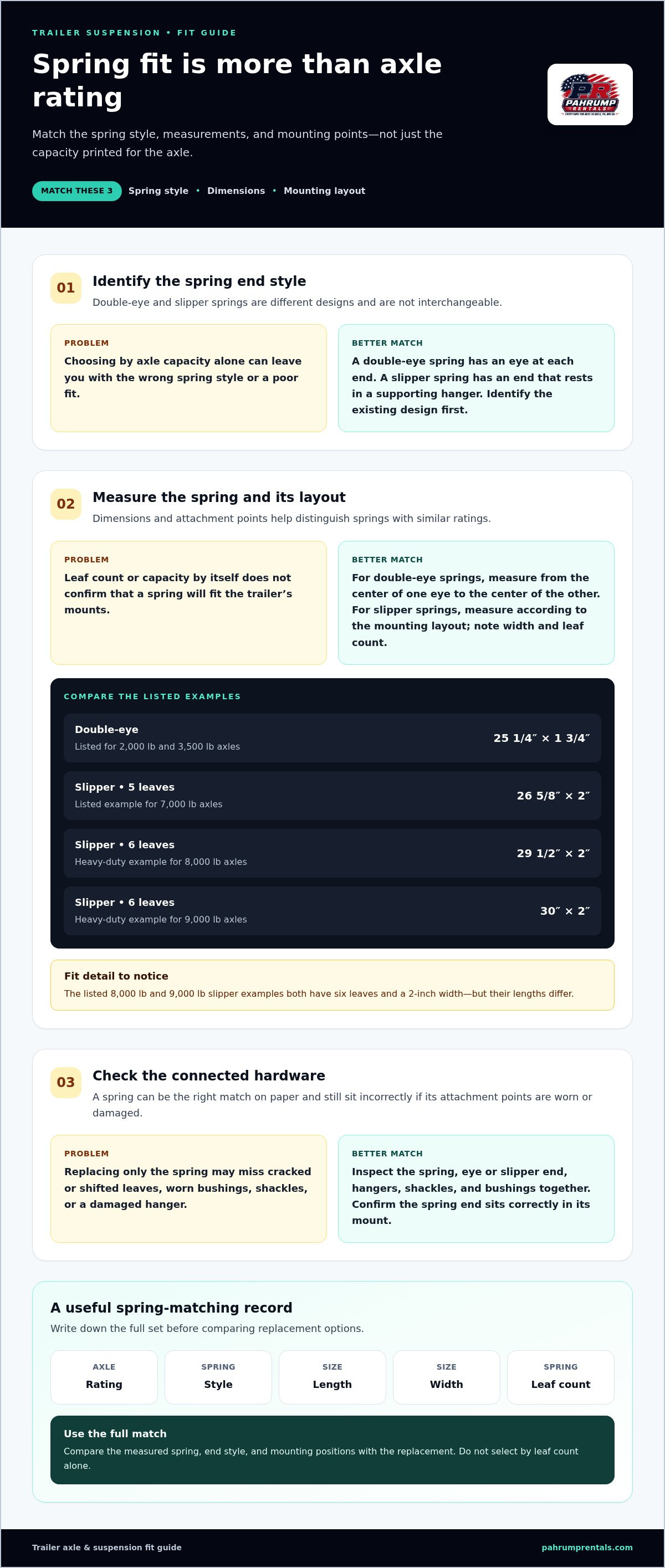
Choose a replacement leaf spring by matching its mounting style, dimensions, and axle capacity. A double-eye spring has an eye at each end; a slipper spring has an end that rests in a supporting hanger. These designs are not interchangeable, so identify the existing spring before comparing replacement options.
For a double-eye spring, measure from the center of one eye to the center of the other. For a slipper spring, measure according to its mounting layout, and note the width and leaf count. Check the hangers and shackles, too. A spring that matches the axle rating but not the trailer’s mounts will not fit correctly.
Listed double-eye examples include a spring measuring 25 1/4 inches by 1 3/4 inches for 2,000 lb axles, and the same measurements for 3,500 lb axles. Slipper spring examples include:
- A five-leaf spring measuring 26 5/8 inches by 2 inches for 7,000 lb axles.
- A six-leaf heavy-duty spring measuring 29 1/2 inches by 2 inches for 8,000 lb axles.
- A six-leaf heavy-duty spring measuring 30 inches by 2 inches for 9,000 lb axles.
These examples show why axle capacity alone doesn’t identify the correct spring. The 8,000 lb and 9,000 lb slipper options both have six leaves and 2-inch widths, yet their lengths differ. Compare the measured spring, end style, and mounting positions with the replacement. Don’t select by leaf count alone.
Inspect the removed spring for cracked, shifted, or visibly damaged leaves. Check that the eye or slipper end sits correctly in its mount, and look for wear on connected bushings and shackles. A damaged hanger can affect how a replacement spring sits, so assess the attachment points along with the spring.
Before ordering, write down the axle rating, spring style, length, width, and leaf count. For example, a five-leaf slipper spring measuring 26 5/8 inches by 2 inches corresponds to the listed 7,000 lb axle example. Use the full set of details to compare options and avoid assuming that a similar-looking spring shares the same fit.
Axle beam replacement
An axle beam replacement addresses damage or deformation in the beam itself, rather than replacing only a spring or bushing. Start by identifying the existing axle’s capacity, brake configuration, and mounting arrangement. Replacement beams are listed in TK configurations for 3500 lb, 6000 lb, and 7000 lb capacities. Match the beam to the trailer’s setup, not capacity alone.
Before selecting a replacement, record the axle identification and compare the old beam’s length, hub placement, and suspension mounting points. Check how the spring seats align with the hangers, since a mismatch can affect installation and wheel position. For example, a 6000 lb TK beam is a capacity reference, not proof that it fits every trailer rated for 6000 lb.
Inspect the full assembly when assessing the axle beam. Look for visible bends, cracks, corrosion, or damaged attachment areas, then examine the hubs, brakes, springs, and hangers. If replacing the beam, determine which connected components can transfer to the new assembly and which show independent wear. This helps reveal related suspension damage that a beam problem might otherwise obscure.
Capacity matters because the replacement must suit the trailer’s axle rating and intended configuration. The available TK examples cover 3500 lb, 6000 lb, and 7000 lb. Those figures identify listed beam capacities, but they don’t describe dimensions or all fitment details. Compare the axle’s identifying information and mounting geometry before choosing among those capacity categories.
- Record the axle rating and brake arrangement.
- Measure the beam and note hub and spring-seat positions.
- Inspect attached suspension and brake components for separate damage.
These checks help define the repair. If the beam is bent but its attached parts remain serviceable, replacing the beam may address the main damage. If hubs, brakes, or mounts are also damaged, include them in the repair plan. Don’t let one visible defect substitute for a full inspection of the axle assembly.
After fitting the beam, confirm that the suspension mounts align and that connected components sit correctly. Recheck wheel position and brake connections as part of the completed work. For a trailer using a 7000 lb TK beam, for example, the rating must match the trailer’s axle configuration, while measurements and mounting details determine fit.
Keep the old axle information, measurements, and inspection notes together when comparing replacement options. That record helps distinguish a capacity match from a complete fit match. The right beam selection depends on both: the listed 3500 lb, 6000 lb, or 7000 lb rating and the trailer’s actual geometry.
Bushings and hangers
Bushings cushion movement at suspension pivots, while hangers anchor the springs to the trailer frame. Together, they help leaf springs move through suspension travel without shifting out of position. A worn bushing can cause looseness at a spring eye or shackle. A bent or cracked hanger can change how the spring sits beneath the frame.
Start by visually inspecting each spring connection. Look for bushings that are split, crushed, or displaced, and check hangers for bending, cracks, or damaged attachment points. Compare both sides. For example, a spring sitting at a different angle on one side may point to a worn connection or damaged mount.
Movement and sound can provide additional clues. A loose spring eye may shift against its hanger, while a worn bushing can allow excess movement at the pivot. Listen for clunks as the trailer crosses uneven ground, then inspect the relevant spring, shackle, and hanger connections. Treat the sound as a clue to locate movement, not proof that a specific part has failed.
Focus the repair on the connection showing wear. Replacing a bushing addresses the pivot interface; replacing a hanger addresses the spring’s frame attachment. Assess both together if each is damaged. A new bushing fitted into a distorted hanger, for example, won’t correct the hanger’s position or repair its attachment.
- Inspect each spring eye, shackle, bushing, and hanger.
- Compare spring position and connection condition across both sides.
- Record which mount shows movement, distortion, or visible damage.
Before choosing replacement components, identify the suspension layout and the mounting points they must fit. Note whether the spring has a double-eye or slipper end, since the two designs connect differently. Hanger shape and bushing fit matter as well. A part that looks similar may not align with the existing spring connection.
After replacing a worn connection, check that the spring sits correctly in its mount and moves without binding. Inspect the adjoining shackle and hanger, too. If a new bushing still sits unevenly, the spring eye or hanger may also need attention. Checking the complete connection helps distinguish a localized repair from wider damage to the suspension mount.
Complete trailer axle replacement
A complete axle replacement addresses the beam and its assembled components when a localized repair won’t resolve the damage. Start matching the replacement by checking the axle rating, brake arrangement, hub pattern, and mounting dimensions.
Axle Capacity, Hub Pattern, and Dimensions
Identify the axle capacity from its markings or trailer records, then compare the replacement’s rating. Listed electric-brake service kits cover 3500 lb, 6000 lb, 7000 lb, 8000 lb, 9000 lb, 10,000 lb in an old-style configuration, 12,000 lb, and 15,000 lb axles. Listed TK beams include 3500 lb, 6000 lb, and 7000 lb capacities.
Before selecting an axle, record its capacity, hub pattern, and dimensions. Count the hub’s stud positions and measure the pattern according to its layout. Compare beam length, hub-face spacing, spring-seat placement, brake type, and mounting points with the existing assembly.
Bearing, Hub, and Brake Inspection
Inspect bearings, hubs, and brakes with the trailer stable and supported by equipment suited to its weight. Keep hands clear of pinch points, and never work beneath an unsupported trailer. Look for visible damage, looseness, contamination, or uneven wear. Check the hub and brake assembly together, since damage in one area may affect connected components.
For a safe inspection, secure the trailer and remove the wheel using the appropriate procedure. Examine the bearing surfaces, hub interior, brake wiring, and visible brake components. Record signs of wear or damage, then compare the findings on both sides of the axle.
Bearing, Hub, and Brake Replacement
For replacement, use parts matched to the axle, hub pattern, and brake configuration. Keep removed components organized by wheel position and follow the replacement part’s installation instructions. Don’t reuse visibly damaged bearing or hub components. Reconnect brake wiring carefully, then check that each component is seated and moves as intended.
Before returning the trailer to service, check that the assembly is securely mounted, connections are aligned, and wiring is intact. A replacement axle may require transferring or replacing hubs and brakes, depending on the assembly. Treat these components as part of the overall fit, not as automatic matches.
Pahrump Rentals & Hardware: Industrial Equipment Rentals
Pahrump Rentals & Hardware offers industrial equipment and tool rentals, along with professional hardware solutions for local projects. Once you’ve identified the axle or suspension work, rentals and hardware can support the equipment and supply needs around the job. Contractors can also use the Contractor Portal to manage project-related needs.
For a trailer repair, first use the axle capacity, brake configuration, and measurements to define the parts and work involved. Then consider whether equipment rentals, tool rentals, or hardware supplies fit the wider project. Contact Pahrump Rentals & Hardware to discuss project support.
Plan the Next Step for Your Trailer
Turn inspection findings into a clear repair plan. Before starting, gather the trailer’s identification details, part measurements, and notes about any damage. This gives you a practical basis for planning the work and identifying equipment or hardware needs. For trailer axle repair parts in Pahrump, keeping these details together makes the next steps easier to organize.
Pahrump Rentals & Hardware offers industrial equipment and tool rentals, as well as professional hardware solutions for local projects. These services can support equipment and hardware needs around a repair; let the inspection findings guide what the job requires.
Take the next step at a pace that suits your project. Contact Pahrump Rentals & Hardware to discuss equipment rentals, tool rentals, or hardware solutions for your work. With a clear plan and the right project support, you can move forward with greater confidence.
Frequently Asked Questions
Where can I buy trailer axle repair parts in Pahrump, Nevada?
For trailer axle repair parts in Pahrump, start by matching the required component to your trailer’s axle and hub details. Pahrump Rentals & Hardware provides professional hardware solutions, RV supplies, and RV repair. Owners travelling from Beaty, Goldfield, or Tonopah can gather the axle identification and part details before planning their parts search.
What trailer axle parts are available locally in Pahrump, such as bearings, hubs, brakes, and springs?
Common axle repair components include bearings, hubs, brake parts, and springs, but the right fit depends on your trailer’s configuration. Before looking for a component, note the axle identification and bring the old part or a clear photo of its markings and connections. Pahrump Rentals & Hardware offers professional hardware solutions and RV supplies for local projects. Match any replacement to the trailer’s specific requirements.


