

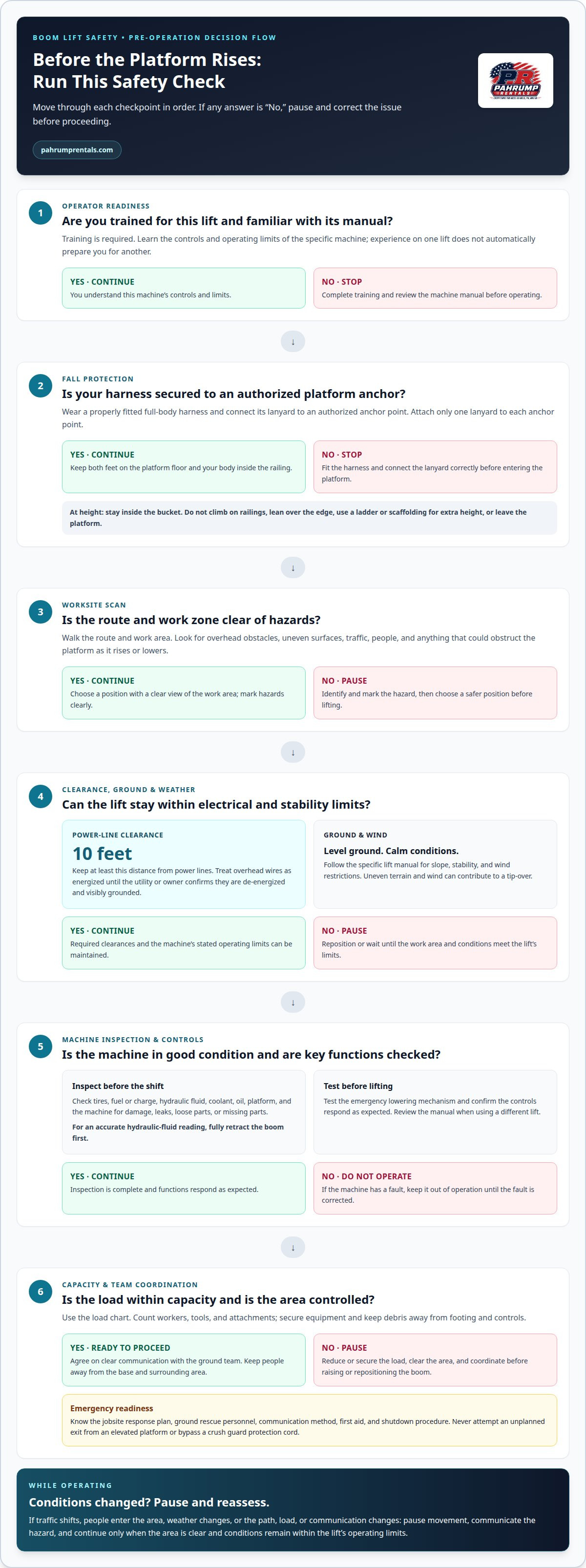
Safe boom-lift operation starts before the platform leaves the ground. Knowing how to operate a boom lift safely means completing training, inspecting the machine before the shift, checking the work area, and staying within the lift’s load limits. Keep at least 10 feet from power lines, and use the machine’s manual to understand its operating limits.
It’s natural to focus on the controls, but selecting the right lift and preparing the site matter just as much. This guide explains how to assess hazards, inspect key components, board and use the platform, and move the boom carefully. It also compares telescopic and articulating boom lifts to help you match the design to the reach and access your task requires.
Key Takeaways
- Match the boom lift type to the access route, reach, and working position the task requires.
- Wear a properly fitted full-body harness and connect its lanyard to an authorized platform anchor point.
- Assess ground conditions, overhead hazards, wind, and the area around the lift before raising the platform.
- Learn the controls for the specific machine, move deliberately, and keep people clear of the lift’s base.
- Choose Industrial Equipment Rentals or Tool Rentals from Pahrump Rentals & Hardware when equipment is needed for a project.
What is a Boom Lift and How do You Operate One?
A boom lift raises a platform, often called a bucket, to reach elevated work areas. Learning how to operate a boom lift safely starts with proper training, suitable fall protection, and steady control of the platform and its load.
-
Confirm Operator Training and Certification
Complete training before operating a boom lift, then learn the controls and limits of the specific machine. OSHA regulations state that only trained persons may operate an aerial lift. The requirement is training, not a named certificate. Don’t assume that experience with one lift prepares you to operate another type. Review its manual before starting work.
-
Wear a Harness and Fall Protection
Put on a properly fitted full-body harness before entering the platform, then connect its lanyard to an authorized anchor point. Attach only one lanyard to each anchor point. Keep both feet on the platform floor and your entire body inside the railing while operating. A harness and lanyard work as a system, so use the designated anchor point, not an improvised attachment.
Stay inside the bucket while it’s elevated. Don’t climb on the railings, lean over the edge, or use a ladder or scaffolding to gain extra height. Never leave the platform at height. These actions take you outside the intended work position and can compromise fall protection.
-
Respond to Emergencies and Disabled Lifts
Follow the jobsite emergency response plan if the lift stops working at height or an emergency occurs. The plan should identify ground rescue personnel, communication methods, first aid, and equipment shutdown procedures. Report the issue using the agreed communication method, and don’t attempt an unplanned exit from an elevated platform.
Before work starts, know how to communicate with ground support and understand the emergency shutdown procedure. A crush guard protection cord can trigger an emergency shutdown if it disconnects from its magnet. Don’t bypass this protection or restart the lift without assessing why it stopped.
-
Keep the platform within its capacity.
Check the lift’s load chart and count workers, tools, and attachments when calculating the platform load. Stay within the listed capacity. Secure tools and equipment so they can’t slide or fall, and stow cords instead of leaving tools hanging in the work area. Keep debris away from your footing and the platform controls. Recheck the load as the work changes to avoid overloading.
-
Coordinate movement with the ground team.
Agree on clear communication with team members before raising or repositioning the boom. Keep people away from the base and surrounding area while the lift operates. Move carefully, maintain clearance from obstacles, and follow the machine’s operating parameters. To operate a boom lift safely, pause whenever the path, load, or team communication changes.
Training, correct harness use, and deliberate movement all matter. Apply these practices consistently when deciding how to operate a boom lift safely on a changing worksite.
Pre-operation maintenance checks and hazard assessment
Before operating, inspect the machine and walk the work area for electrical, terrain, weather, collision, and crushing hazards. Keep at least 10 feet from power lines, and use the lift’s manual to understand its wind and slope limits.
-
Assess Worksite Hazards
Walk the route and work zone before positioning the aerial lift. Identify overhead obstacles, uneven surfaces, traffic routes, people, and anything that could obstruct the platform as it rises or lowers. Mark hazards clearly and choose a position that gives the operator and ground team a clear view of the work area.
-
Check Terrain, Electrical, and Weather Hazards
Position an outdoor lift on level ground and work in calm conditions. Uneven terrain and wind can contribute to a tip-over, so follow the manufacturer’s slope and stability limits. Review the specific machine’s manual for wind restrictions. Keep at least 10 feet from power lines; the Occupational Safety and Health Administration treats overhead wires as energized until the utility or owner confirms de-energization and visible grounding.
-
Prevent Collision and Crushing Hazards
Set a clear boundary around the lift’s base, then keep workers and pedestrians outside it while the machine moves. Coordinate with the ground team before raising or lowering the platform, and watch for traffic, walls, ceilings, and other obstacles. Check overhead, beside, and beneath the platform throughout movement to reduce collision and crushing risks.
-
Inspect the machine before the shift.
Check the tires, fuel or charge level, hydraulic fluid, coolant, oil, platform, and machine for damage or leaks. Look for loose or missing parts that could affect safe operation. If the machine has a fault, don’t operate it until it’s corrected. For an accurate hydraulic-fluid reading, fully retract the boom before checking the level.
-
Test key functions before lifting.
Review the manual when using a different lift, including a telescopic boom lift whose controls or operating limits may differ. Test the emergency lowering mechanism before use. Confirm that the controls respond as expected, then check the base and surrounding area for workers or obstructions before operating the lift.
-
Reassess when conditions change.
Repeat the hazard scan if traffic shifts, workers enter the area, or weather changes. A clear path, for example, can become blocked by a delivery vehicle, while rising wind can make an elevated platform less stable. Pause movement, communicate the new hazard, and reposition only when the work area is clear and conditions are within the lift’s operating limits.
For a different lift, review its manual for wind restrictions; assess overhead obstacles and uneven surfaces. Check clearances overhead, beside, and underneath. Circle checks should take no longer than two minutes; use wheel chocks on inclines.
Inspecting and maintaining boom lifts
-
Complete a pre-use inspection before each operation.
Inspect the boom lift before every use, even if it looks ready from a distance. Check fluid levels, wheels and tire pressure, controls, steering, the hydraulic system, cables, wiring, and loose or missing parts. OSHA recommends checking these components. A defect in a control, tire, or hydraulic line can affect movement, stability, or the platform’s response.
-
Use the manual to guide the inspection.
Read the operator’s manual for the specific machine, especially when switching models. A telescopic boom lift may have different inspection points or controls from another lift design. Follow the manual’s instructions for checking fluids and operating systems, and use its maintenance guidance rather than relying on assumptions from a previous machine.
-
Record and report any fault.
Record what failed, where the problem appeared, and when it was found. Examples include a control that doesn’t respond normally, a hydraulic leak, damaged wiring, or a loose component. Take a faulty boom lift out of service until the issue is corrected. Don’t continue operating it because the problem seems minor or intermittent.
-
Keep routine maintenance tied to the machine’s requirements.
Use the manual and maintenance records to track inspections, repairs, and scheduled servicing. Follow the lift’s specified service instructions rather than inventing an interval. Clear records show what work has been completed and can help identify recurring issues, such as repeated leaks or tire damage, before the next shift.
-
Check the full work envelope after maintenance.
Before returning the lift to use, make sure service work is complete and the machine is ready to operate. Confirm that the controls, steering, cables, wiring, and hydraulic components have been checked, and that loose or missing parts have been addressed. Keep the operator’s manual available so the person using the lift can follow its model-specific instructions.
-
Secure and inspect the lift after use.
At the end of the job, secure the boom lift, retract the boom, and complete post-operation checks. Look again for leaks, visible damage, or changes in the controls or equipment that occurred during the shift. Record new faults and keep the machine out of service if they affect safe operation. Report them for correction before the next use.
At the end of the shift, secure the boom lift, retract the boom, and complete post-operation checks before finishing work.
Operating controls and boom movement
Use the controls identified in the specific lift’s manual, because layouts and responses vary by machine. Make each movement deliberately, with a clear path for the platform and workers on the ground.
-
Use Ground Controls
Identify the ground control station and review its functions in the machine’s manual before operation. Keep a ground worker in position to communicate with the platform operator, and use these controls only as the manual directs. If the basket operator needs help, the ground worker should follow established lift procedures rather than guess at switches or control sequences.
-
Use Basket Controls
Before moving from the basket, identify the controls for that lift and understand how each responds. Use the foot pedal to enable machine movement while operating from the basket. Keep the platform clear of loose tools, and release the pedal or control if movement differs from what you intended. Don’t reach for an unfamiliar control while elevated.
-
Control Boom Movement
Move the boom only after checking the planned path above, beside, and below the platform. Use controlled inputs to raise, lower, or position the boom, and pause if an obstacle enters the work envelope. A telescopic boom extends outward, so consider where its reach will place the platform before changing position. Follow the manual’s operating procedures.
-
Coordinate each move with workers on the ground.
Agree on clear communication before raising or repositioning the platform. Tell ground workers before movement, and stop if signals are unclear or someone enters the area. Keep the base clear while the lift operates. This coordination helps prevent someone from walking beneath the boom or into the machine’s travel path.
-
Keep the lift stable as you work.
Operate the machine within its specified parameters, and avoid abrupt movements that can unsettle the platform. The lift becomes less stable as its height increases, so take extra care when elevated. Keep the platform load within the load chart, including workers, tools, and attachments. If the position or ground conditions change, stop and reassess before continuing.
-
Stop movement before changing the plan.
If a control responds unexpectedly, an obstacle blocks the route, or communication is lost, stop moving. Keep the platform stable and follow the manual’s procedures to determine the next control action. Don’t force a control or continue simply to finish the task. Resume only when the path is clear and the team is ready.
Boom lift types and their uses
Choose a boom lift by matching its reach and movement to the work area. Telescopic and articulating designs address different access needs, so consider both the target and the route to it.
-
Choose a telescopic boom lift for direct reach.
A telescopic boom extends outward in a straight line, making it useful when the work area is accessible from a clear approach. Some telescopic boom lifts can reach heights of up to 100 feet. For example, a task on an open exterior wall may suit this design if the lift can be positioned below the work without blocking the extension path.
-
Choose an articulating boom lift to reach around obstacles.
An articulating boom uses jointed sections to position the platform along a less direct path. These lifts are generally between 30 feet and 80 feet tall, and articulating boom lifts can rotate 360 degrees. This movement can help reach work above or behind an obstacle, such as a rooftop edge or fixed equipment, when a straight approach is obstructed.
-
Compare the required working height with the machine’s reach.
Depending on the model, boom lifts can provide working heights of approximately 30 feet to more than 180 feet. Commercial straight boom lifts are between 40 feet and 135 feet tall. Treat these as different measures: the lift’s stated height and the work position required for the task both matter. Check the specific manufacturer’s specifications before selecting a machine.
-
Match the lift to the site, not just the height.
Measure the available approach and identify overhead, side, and ground-level obstructions. A telescopic boom may suit an open route, while an articulating boom may work better where the platform needs to bend around an obstacle. In either case, compare the planned position with the lift’s operating limits and the actual site layout.
-
Factor stability, weather, and tipping risk into selection.
A higher reach doesn’t make a lift suitable for every site. Boom lifts become less stable as height increases, and wind or uneven terrain can contribute to tipping. Review the manufacturer’s slope and wind limits for the specific model. An outdoor task on level ground in calm conditions has different constraints from elevated work near uneven ground or in exposed, windy conditions.
-
Make the final selection from the work plan.
Write down the target height, approach direction, obstacles, ground conditions, and expected weather. Compare those needs with the model’s reach and operating limits. For example, a clear, straight path may favor a telescopic design, while a task that requires reaching around equipment may favor an articulating boom. The right type is the one that fits the entire route and work position. For contractors looking to purchase pre-owned machinery rather than rent, consulting a used boom lift buying checklist can help evaluate machine condition and operational history before making a decision.
Pahrump Rentals & Hardware
Pahrump Rentals & Hardware offers industrial equipment rentals for local projects. After matching the lift type to the work area and planning the safety procedures, consider whether renting equipment fits your project. Professional hardware solutions and tool rentals can also support related work, and contractors can use the Contractor Portal to manage rental and hardware needs.
For a task that specifically requires a boom lift, base your choice on reach, access, ground conditions, and the machine’s operating limits. Pahrump Rentals & Hardware offers industrial equipment rentals for local projects. Contact Pahrump Rentals & Hardware to discuss your project requirements.
Put a Safer Work Plan Into Practice
Make the next elevated task easier to manage by turning its requirements into a clear work plan. Before the crew arrives, define the access route, work position, communication method, and response plan for changing site conditions. This gives everyone a shared reference and helps the team make deliberate decisions as the job develops.
Learning how to operate a boom lift safely is part of preparing for every task. A new site, a different machine, or a change in the work area can call for a fresh review of the plan. Keep training, equipment selection, and site coordination connected to the actual work so safe practices remain practical throughout the job.
For project support, Pahrump Rentals & Hardware offers Industrial Equipment Rentals, Professional Hardware Solutions, and Tool Rentals. Contact Pahrump Rentals & Hardware today to discuss your project needs and take a steady next step.
Frequently Asked Questions
What Is an Aerial Lift?
An aerial lift is a powered machine that raises workers on a platform to reach elevated work areas. A boom lift is one type: its boom positions the platform vertically and outward, helping workers access areas that a fixed ladder cannot reach. For example, the platform can be positioned near an overhead work point while the machine remains on the ground below.
What pre-use inspection checks should be completed before operating a boom lift?
Before use, inspect the machine’s tires, fluid levels, power source, hydraulic system, steering, controls, cables, wiring, platform, and visible components. Look for leaks, damage, loose parts, or controls that don’t respond normally. Compare the machine with its manual, report any fault, and keep the lift out of service until the fault is corrected.
How do you safely set up and operate a boom lift step by step?
Start by reviewing the specific lift’s manual and confirming the operator is trained. Inspect the machine, assess the route and work area, and position the lift within the manufacturer’s operating limits. Put on fall protection, secure tools, and communicate the movement plan to the ground team. Keep at least 10 feet from power lines, move deliberately, and stop if the route becomes obstructed.
How do wind, weather, ground conditions, and slopes affect safe boom lift operation?
Wind can make an outdoor lift less stable, while uneven ground can contribute to tipping. Follow the specific machine’s manual for wind restrictions and the manufacturer’s slope and stability limits. Operate outdoors on level ground and in calm conditions. For work around Pahrump, Beaty, Goldfield, or Tonopah, assess the actual site rather than assuming conditions are the same across locations.
What are the boom lift's load limits, platform capacity, and safe positioning requirements?
The lift’s load chart sets the allowable platform capacity. Count workers, tools, and attachments together against that limit. Keep both feet on the platform floor, remain inside the railing, and position the lift so the boom reaches the work without exceeding its operating limits.


