
The lowest-priced fastener can become the more costly choice if it doesn’t suit the job. A fastener is a mechanical device that joins or secures components, and choosing the right fastener for the job means matching its material, length, diameter, and thread pitch to the workpiece, load, and environment. Quality matters alongside price because a poor match can lead to corrosion, loosening, or thread damage.
It’s easy to focus on price or grab a fastener that looks close enough. But the right choice depends on how the connection will be used and what it must withstand. A fastener for a damp setting, for example, calls for different material considerations than one used indoors in a dry space.
This guide explains what fasteners do and how to compare their material, size, and thread options. It also covers why quality standards and the operating environment deserve attention before price alone guides your decision, so you can find a practical match for the work.
Key Takeaways
- Match fastener material to moisture, chemicals, and other conditions where the connection will be used.
- Choose the fastener type for the connection, such as a bolt for use with a nut or a rivet for a permanent joint.
- Size length, diameter, and thread pitch to the workpiece to help reduce loosening and thread damage.
- Consider load and vibration when selecting fastener strength, and use the appropriate grade for the application.
- Weigh quality and applicable manufacturing standards alongside purchase price to help avoid premature maintenance or replacement.
1. Why shouldn't you choose a fastener based only on price?
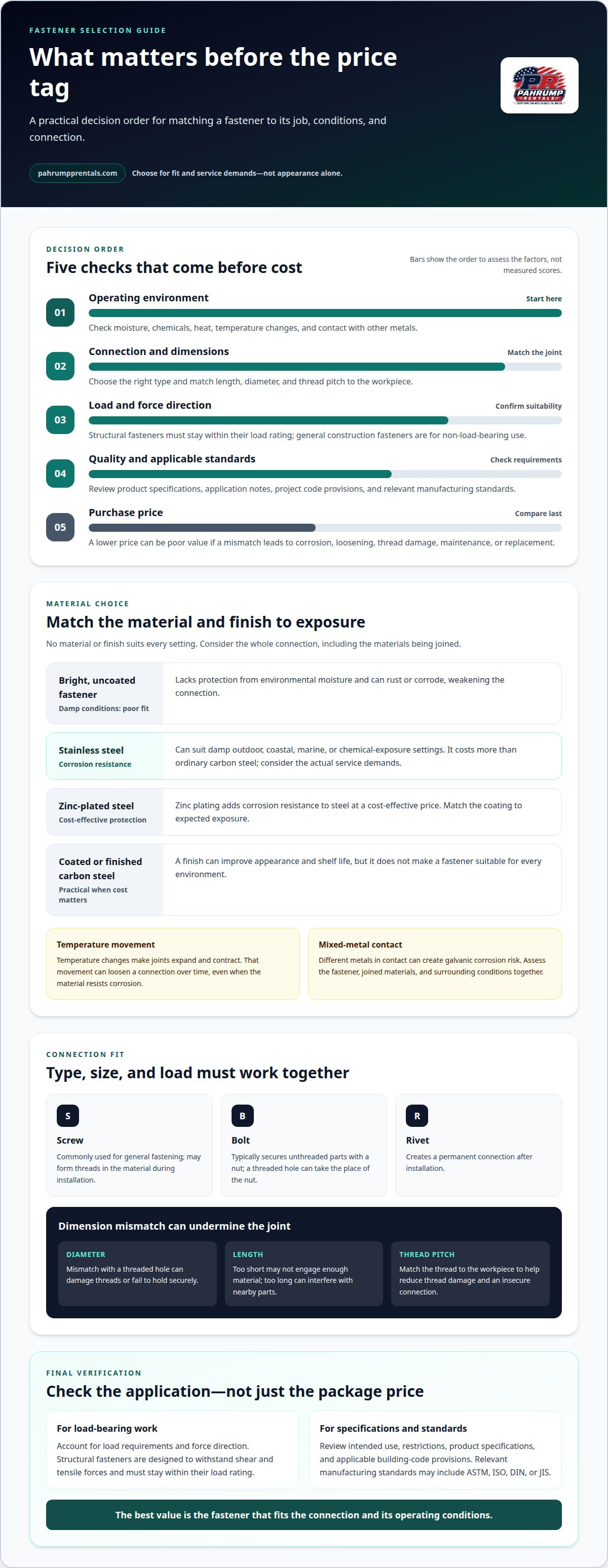
A low purchase price can be misleading when a fastener faces moisture, chemicals, or heat. Choosing the right fastener for the job starts with its operating environment. A bright, uncoated fastener lacks protection from environmental moisture, so it can rust or corrode in damp conditions and weaken the connection. That makes the cheapest option a poor fit for some projects.
Stainless steel offers strong corrosion resistance in outdoor settings, including coastal environments, and can suit areas with high moisture or potential chemical exposure. It costs more than ordinary carbon steel, so choose based on exposure and service demands. A dry indoor connection may not need the same level of corrosion resistance. Compare the environment with the fastener’s intended use before weighing price.
Zinc plating adds corrosion resistance at a cost-effective price. Coated or finished carbon steel can be a practical choice when cost matters, and a finish can also improve appearance and shelf life. However, no finish makes every fastener suitable for every environment. Match the coating to expected exposure, especially where water, humidity, or chemicals may reach the connection.
Consider temperature as well as moisture. Extreme temperature changes make fastened joints expand and contract, and that movement can loosen a connection over time, even if the material resists corrosion. Consider where the assembly will operate and how much temperature variation it may face. When temperatures change, both the material and connection requirements matter.
Galvanic corrosion is another reason to assess the full connection, not just the fastener. Contact between different metals can create a corrosion risk. Consider the fastener material alongside the materials it joins and the surrounding conditions. Even when stainless steel is chosen for moisture resistance, the other metals in contact still matter. Price alone can’t tell you whether the materials are compatible.
Thread galling can affect stainless steel and aluminium fasteners. Too much pressure between contacting thread surfaces increases friction and heat, which can fuse and seize a nut and bolt together. Account for this risk when selecting threaded fasteners, particularly with susceptible materials. A secure connection depends on more than initial fit. Assess corrosion, temperature, chemical exposure, coating, and thread contact before treating a lower price as better value.
2. What Happens If the Wrong Fastener Size Is Selected?
For structural work in the United States, fastener selection must account for the project’s load requirements and applicable building-code provisions. Manufacturing standards such as ASTM, ISO, DIN, and JIS can also inform product selection. The relevant requirements depend on the fastener and its application.
Fastener types serve different purposes, so size alone can’t make an unsuitable type work. Screws are commonly used for general fastening and may form threads in the material during installation. Bolts typically secure unthreaded parts with a nut, although a threaded hole can take the place of the nut. A rivet creates a permanent connection after installation. Matching the type to the joint is a practical first step.
A bolt-and-nut connection, for example, suits parts that need to be clamped together. A washer can spread the bearing load across a larger surface and help protect the material. A self-tapping fastener forms its own threads, while a self-drilling fastener can create its own hole. Choose based on the workpiece and installation needs, not appearance alone, because these fasteners serve different functions.
Wrong dimensions can prevent a fastener from engaging properly. A diameter that doesn’t match a threaded hole can damage the threads or fail to hold securely. For fabricators and machinists drilling precise pilot or mounting holes for fasteners, machining guides on ridiculousmachinetools.com explain how proper toolholding and drill setups support accurate work. A fastener that’s too short may not engage enough material; one that’s too long can interfere with nearby parts. Either way, the connection may loosen or fail to perform as intended. Match the size to the joint before choosing a fastener type.
Load affects the choice. Structural fasteners are designed to withstand shear and tensile forces, and they must stay within their load rating. General construction fasteners are intended for non-load-bearing applications, not connections exposed to those forces. Don’t treat a screw suited to light-duty fastening as a structural substitute. Knowing the load and direction of force helps identify the right application.
Packaging provides useful selection details. Read the application notes and intended-use information, then compare them with the materials being joined and the connection’s load. Look for restrictions and product specifications relevant to the job. If the package identifies a fastener for non-load-bearing use, don’t use it in a structural joint. This review helps catch a size or type mismatch before installation.
The applicable building-code provisions and manufacturing standards depend on the fastener and its application. Selection should account for the project’s code requirements and relevant standards such as ASTM, ISO, DIN, or JIS.
3. Matching material to the operating environment
Choose fastener material by considering the load, joined materials, and surroundings together. Carbon steel is the most common fastener material, but it isn’t right for every exposure. Stainless steel offers corrosion resistance for damp outdoor settings, while coated or finished carbon steel can suit projects where cost matters. Let the operating environment guide the choice before appearance or price.
For rust and corrosion resistance, stainless steel can suit outdoor, marine, and chemical-heavy environments. Zinc plating adds corrosion resistance to steel at a cost-effective price. Coated or finished carbon steel can also help in environments exposed to humidity or water. The best option depends on the exposure and the connection’s requirements.
Match the fastener to the material it will join, not just the environment. A self-clinching fastener, for example, needs a panel material that is ductile and softer than the fastener. During installation, this lets the panel flow around the fastener and form a secure fit. If the panel is too hard or otherwise unsuitable, the fastening method may not work as intended.
Strength grade matters when a connection faces high loads or vibration. Carbon steel fastener grades include 4.6, 4.8, 5.6, 8.8, 10.9, and 12.9. A grade that’s too low for demanding service can stretch, loosen, or snap during operation. Consider the load and vibration together, then select a grade suited to those demands. A higher grade alone doesn’t make a mismatched fastener suitable.
Materials also affect how a fastener behaves during installation. Aluminium and austenitic stainless steel can be vulnerable to thread galling or stripping under too much pressure. For a self-clinching fastener installed in stainless steel, choose one designed for that application, with appropriate strength and resistance. Matching the fastener to the workpiece helps avoid installation problems and supports a dependable connection.
Coatings should suit the base material and expected exposure. Zinc-plated steel provides corrosion resistance, while an uncoated bright fastener lacks protection from environmental moisture. A coating won’t replace the need to consider load, vibration, or compatibility between joined metals. Treat material, finish, and application as related decisions, not separate shopping choices.
Start with three checks: identify the surrounding conditions, identify the materials being joined, then assess load and vibration. For a humid outdoor panel, compare corrosion-resistant materials and confirm the fastener suits the panel. For a vibrating, high-load assembly, consider grade and application suitability alongside environmental resistance. These checks make material selection more precise and relevant to the job.
4. Fastener length, diameter, and thread pitch
Start with the workpiece and the threaded connection it needs. Fastener diameter, length, and thread type must match the workpiece to reduce loosening and thread damage. Measure length from beneath the head to the tip, then compare it with the material thickness. A fastener that’s too short may not engage enough material, while excess length can interfere with nearby components.
For imperial screws smaller than ¼ inch, size is identified by a gauge number. For imperial bolts that are ¼ inch or longer, measure across the threads to determine diameter. Use the same thread system as the mating part: metric threads must match metric threads, and inch threads must match inch threads. A mismatch can prevent smooth engagement or damage the workpiece.
Thread pitch describes the spacing between threads. For an imperial fastener, count the threads within a one-inch section of its threaded portion. Coarse threads, identified as UNC, generally allow quicker assembly; fine threads, identified as UNF, provide closer thread engagement and can accommodate greater tension. Choose based on the application and mating thread, rather than assuming finer or coarser is always preferable.
Load requirements matter, too. Selecting the appropriate thread size is important for meeting a threaded fastener’s load requirements. Fine threads can provide a more secure connection where greater tension is needed, while UNC threads are commonly used and are easier to remove. For bolts with a diameter of 1 inch or greater, constant-pitch options include 8, 12, or 16 threads per inch. Match the specified pitch to the threaded hole or nut.
Most fastener threads are right-handed unless otherwise specified. A right-handed fastener tightens clockwise; a left-handed thread is used when the application calls for it. Don’t force a screw or bolt that resists turning. Binding can signal an incorrect pitch, incompatible thread system, or misalignment, and force can damage the threads.
Common installation mistakes include choosing the wrong length, mixing metric and inch threads, and forcing a mismatched fastener. These errors can cause stripping, galling, a seized nut and bolt, or a loose connection. Aluminium and austenitic stainless steel threads are especially susceptible to galling or stripping under too much pressure. Apply controlled pressure during installation and keep the fastener aligned with its mating hole.
5. Choosing fasteners based on quality, not price alone
A low price doesn’t show whether a fastener suits its intended use. Quality starts with a match between the fastener’s grade, dimensions, material, and application. A fastener intended for a light-duty connection, for example, isn’t automatically suitable for a demanding assembly. Compare the product’s stated specifications with the job requirements before making price the deciding factor. The right match helps avoid replacing a poor choice after installation.
Strength grades provide one useful comparison for load-bearing needs. Grades 4.8, 8.8, 10.9, and 12.9 affect a fastener’s load-bearing capacity. A grade that’s too low for high loads or vibration can stretch, loosen, or snap during operation. A higher grade isn’t automatically the right choice either. Match the specified grade to the connection’s requirements instead of treating the highest number as the safest option.
Manufacturing standards offer another way to compare fasteners. Products made to standards such as DIN, ISO, ASTM, or JIS provide a more defined basis for comparison. These identifiers matter because similar-looking fasteners can have different specifications. Use the standard named for the application, then compare the product details with the required size, thread, material, and strength. A standards mark is useful when it matches the job, not as a substitute for that match.
Inspect fastener inventory before installation. Separate products by type and specification, then read packaging notes about intended use. For example, don’t treat a package marked for non-load-bearing construction as suitable for a structural connection. Confirm the grade and thread match the application, and keep unlike fasteners separate. This simple receiving step can catch selection errors before they reach the work area.
Consider the full cost of a mismatch, not just the purchase price. A fastener that doesn’t meet the required standard or suit the application may lead to maintenance, repair, or replacement. Washers can distribute load and protect surfaces, but they don’t make an unsuitable fastener appropriate. Secure installation also depends on compatible parts and specifications. Comparing quality with price helps reduce avoidable rework.
For a practical selection, first identify the connection’s load and use. Next, compare the stated grade, thread, and material with those requirements. Then review relevant standards and application notes before installation. This makes price one factor in the decision, rather than the only one. Explore fastener options by matching product specifications to your project needs.
Pahrump Rentals & Hardware
Pahrump Rentals & Hardware offers professional hardware solutions for readers sourcing fasteners for a specific project. Turn to us when you need hardware suited to your work, whether you’re planning a repair, construction task, or equipment-related job. Matching material, dimensions, thread, and application requirements helps narrow the options before purchase.
Contractors can also use the Contractor Portal as part of their work with Pahrump Rentals & Hardware. For projects that need tools or equipment alongside hardware, Tool Rentals and Industrial Equipment Rentals may also fit the task. Each offering supports a different project need, so choose the one that aligns with the work ahead.
Contact Pahrump Rentals & Hardware to discuss your hardware needs.
Make Your Next Fastener Choice with Confidence
Your next project is an opportunity to match the fastener to the work it must do. Before selecting hardware, identify the demands the connection will face and the details that must align. This practical habit makes choosing the right fastener for the job part of sound project planning, not a last-minute purchase decision.
If you’re preparing for a repair, construction task, or equipment project in Pahrump, Beaty, Goldfield, or Tonopah, Pahrump Rentals & Hardware offers professional hardware solutions, tools, and industrial equipment rentals. Tell us what you’re working on and what hardware or equipment you need. A clear conversation can help you take the next step with confidence.
Contact Pahrump Rentals & Hardware to discuss your project needs. With a thoughtful plan and the right resources, you can move forward prepared.
Frequently Asked Questions
What Is a Fastener?
A fastener is hardware designed to connect or secure two or more components. Screws, bolts, nuts, washers, and rivets are common examples, each serving a different role. A washer, for instance, can help spread pressure beneath a bolt head. Fasteners can create joints intended for removal or permanent connections, so the parts being joined and maintenance needs help determine the right choice.
What Happens If the Wrong Fastener Size Is Selected?
The connection may not hold as intended, and the workpiece or fastener threads can be damaged. An oversized fastener, for example, may not fit its mating hole, while an undersized one may fail to engage properly. Excess length can also obstruct nearby parts. Before installation, compare the fastener’s dimensions with the hole, material thickness, and surrounding components to prevent fit problems.
Why shouldn't you choose a fastener based only on price?
Price alone doesn’t show whether a fastener meets the job’s material, load, and environmental requirements. A low-cost choice that fails in service can lead to maintenance, repair, or replacement. Consider the fastener’s application notes, grade, and manufacturing standard alongside its price. For example, a connection exposed to vibration needs an appropriate fastener, not simply the least expensive item that appears to fit.
What types of fasteners are available and what are they used for?
Common types include screws, bolts, nuts, washers, studs, and rivets. Screws often fasten components directly, while bolts commonly work with nuts or threaded holes. Washers spread load and protect surfaces; rivets form permanent joints. Self-tapping fasteners form threads during installation, while self-drilling fasteners create their own hole. Choose based on the joint’s function, materials, installation method, and whether later disassembly matters.
How do I choose the right fastener for the materials being joined?
Start by identifying both materials, the environment, and the connection’s demands. A damp exterior project may call for corrosion-resistant material, while a self-clinching fastener needs a panel that is ductile and softer than the fastener. For projects in Pahrump, Beaty, Goldfield, or Tonopah, Pahrump Rentals & Hardware offers fasteners and professional hardware solutions for local projects.
How do fastener size, length, diameter, and thread type affect selection?
These details determine whether the fastener fits the workpiece and engages its mating threads correctly. Length should suit the material thickness without interfering with nearby components. Diameter and thread system must match the hole, nut, or other fastened part. For instance, metric threads won’t properly match inch threads. Matching these details helps prevent loose connections, binding, and damage during installation.
How do I calculate the load capacity and strength needed for a fastener?
Begin with the connection’s load demands and whether forces act in tension, shear, or both. Then use the fastener’s stated load rating and strength grade for the intended application. Don’t infer capacity from appearance or grade alone; the connected materials and joint design also affect performance. For a structural connection, select a fastener intended for structural use and keep its application within its rating.
When should I use screws, bolts, nails, rivets, or anchors?
Use screws for direct fastening, bolts to clamp parts with a nut or threaded hole, and rivets for permanent connections. Nails are commonly used to fasten wood, while anchors help secure a fastener in a base material that cannot provide a suitable threaded connection on its own. The right option depends on the substrate, expected load, installation access, and whether you’ll need to remove the joint later.


