
The right saw for a Goldfield concrete job depends on more than the material. A tool suited to a long slab cut may not fit a tight doorway or shallow trench, so concrete saw rental Goldfield planning should start with the cut itself. Then consider blade choice, required depth, site access, and how you’ll manage dust.
Plan ahead for buried utilities, equipment transport, and the time needed to prepare the site, especially when the project is outside a larger service center. Pahrump Rentals & Hardware provides industrial equipment and tool rentals for projects in Goldfield and nearby communities. This guide will help you compare saw categories, prepare a safer work area, and organize your rental plan. We’ll cover saw types, details to sort out before cutting, and how professional customers can use the contractor portal to support rental and project management.
Key Takeaways
- For concrete saw rental Goldfield projects, define the material, cut shape, access, and intended result first.
- Match the saw configuration and diamond blade to the cut, then compare the required depth with the manufacturer’s specifications.
- Prepare the work area by clearing obstacles, locating utilities, keeping bystanders away, and protecting nearby property.
- Plan equipment transport and rental timing around the site and project details.
- Use Pahrump Rentals & Hardware’s equipment rental catalog to plan equipment needs. Professional customers can use the contractor portal for rental and project management.
Concrete Saw Rental in Goldfield: Start With the Cut You Need to Make
Before choosing equipment, define the job: what material needs cutting, what shape the cut should take, how much room is available, and what result you need. A concrete saw is a powered cutting tool used to make controlled cuts in concrete and masonry. The task might involve a straight cut across a slab, trimming an edge, or making an opening. Each calls for different reach, control, and working space.
The cut and work area determine which rental category makes sense. A long floor cut in an open area presents a different handling challenge from a short cut beside a wall. For concrete saw rental Goldfield planning, start with the work rather than choosing equipment by name alone.
What concrete-cutting job are you planning in Goldfield?
Distinguish a long floor cut from a short, controlled cut. A straight line across an accessible slab requires a different approach from an edge cut along a boundary or a small opening where precision and access matter. Nearby walls, corners, obstacles, and limited room to position and guide the saw can all affect the practical choice.
Before planning the rental, write down the material, cut length, and required depth. Note whether the cut is straight or shaped, and describe the access available. These details give you a sound basis for comparing saw configurations and manufacturer specifications.
When is renting a concrete saw a practical choice?
Renting can suit a defined project when you need cutting equipment for a specific task but don’t need to keep it for ongoing use. A homeowner making an occasional opening may have different planning needs from a professional crew that cuts concrete regularly. For recurring work, consider how often the equipment will be used and how it fits into your broader equipment workflow. The right approach depends on the project.
Saw configuration affects control and reach, while the blade needs to suit the material and cut. Diamond blades are commonly used for concrete cutting. For a general overview of types of concrete saws and their blades, see the Wikipedia article on concrete saws. Use the planned cut, available space, and required depth to guide your comparison rather than relying on a category label alone.
Good equipment planning also covers preparation, transport, and the time needed to complete the cut. Pahrump Rentals & Hardware serves Goldfield and surrounding communities with tool and industrial equipment rentals. A clear description of the work helps organize the rental plan and keeps the equipment decision tied to the task.
How Concrete Saw Types and Diamond Blades Affect the Cut
A saw’s configuration influences how you guide it, how close it can work to an edge, and how it fits the space around the cut. The blade and cutting method matter too. For concrete saw rental Goldfield planning, consider all three together: saw type, material, and site conditions. A tool suited to an open slab may be awkward in a confined area, even if both jobs involve concrete.
Handheld and walk-behind saws: what changes between them?
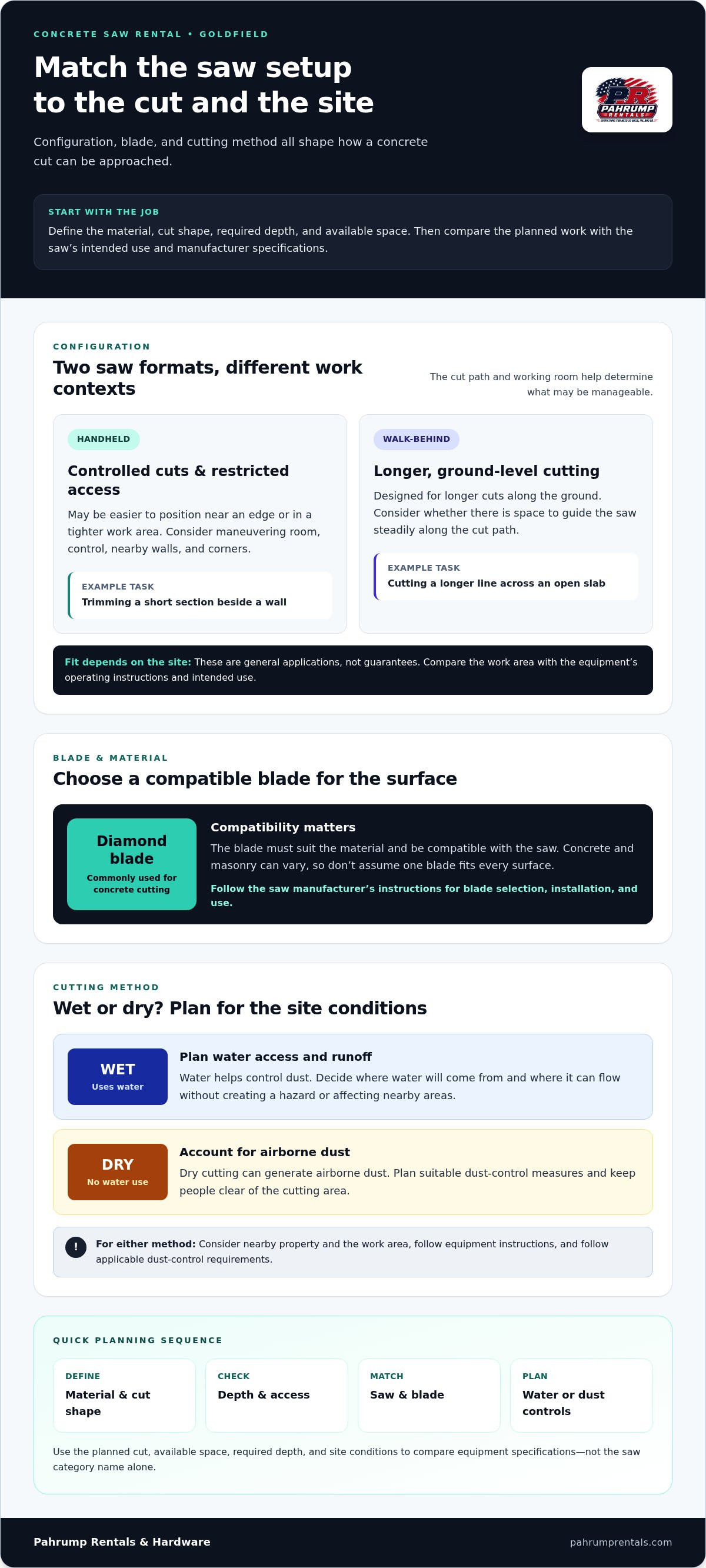
Handheld saws suit controlled cuts and restricted access; walk-behind saws are designed for longer, ground-level cutting tasks. A handheld configuration may be easier to position near an edge or in a tighter work area, while a walk-behind format lets the operator guide a cut along the ground. These are general applications, not guarantees of fit. The planned cut and available space still matter.
Consider two jobs: trimming a short section beside a wall, then cutting a longer line across an open slab. The first calls for attention to maneuvering room and control. The second calls for a setup that can travel steadily along the cut path. Nearby walls, corners, surface access, and obstacles can change what feels manageable. Don’t choose by saw category alone. Compare the work area with the equipment’s operating instructions and intended use.
How do blade choice and cutting method matter?
Diamond blades are commonly used for concrete cutting, but a blade must suit the material and be compatible with the saw. Concrete and masonry can vary, so don’t assume one blade is right for every surface. Follow the saw manufacturer’s instructions for blade selection, installation, and use. Matching the blade to the material keeps the cutting plan within the equipment’s designed application.
Wet and dry cutting also create different site considerations. Wet cutting uses water to help control dust, so plan for water access and manage runoff around the work area. Dry cutting avoids water use, but can generate airborne dust and requires suitable dust-control measures. Neither method automatically fits every site. Consider nearby property, the work area, and the controls required for the task.
- For wet cutting: Plan where water will come from and where it can flow without creating a hazard or affecting nearby areas.
- For dry cutting: Account for dust at the source and keep people clear of the cutting area.
- For either method: Follow equipment instructions and applicable dust-control requirements.
Use these factors to narrow the rental category, then include the equipment rental catalog in your project planning. Matching configuration, blade, and cutting method to the job gives you a clearer basis for the next step: comparing cut depth and access needs with equipment specifications.
Compare Concrete Saw Rental Options for Your Goldfield Project
A useful comparison starts with the cut, not a saw label. The same material may call for different equipment depending on whether you’re making one short edge cut or several long lines across an open surface. For concrete saw rental Goldfield planning, compare the cut’s location and depth with the work area, operating method, and manufacturer’s specifications.
| Project need | Category to consider | Work-area and operating considerations |
|---|---|---|
| Short or controlled cut near an edge | Handheld saw | Consider maneuvering room, nearby walls, and how you’ll guide the cut. |
| Long, ground-level cut across an accessible surface | Walk-behind saw | Consider a clear path for the equipment and space to work along the cut. |
| Cut in a restricted or unusual work area | Compare configurations against the site | Access, obstacles, and the required result may matter more than the broad category. |
Which rental criteria should decide between saw categories?
Compare cut length, location, material, and available working space. A short cut beside an obstruction may prioritize positioning and control, while a longer cut across an open surface may make steady ground-level operation more relevant. If the project involves cuts in different locations, consider how easily the equipment can move between them. Assess power source and operating requirements against the specifications for the equipment.
Check required cut depth separately from saw category. Use the manufacturer’s stated cutting capacity and operating instructions to determine whether the equipment suits the job. Don’t infer depth from a saw’s appearance or assume that a blade choice changes what the saw can cut. Saw selection and blade selection are related but separate decisions: first identify a suitable saw configuration, then match the blade to the material and manufacturer’s guidance.
What project details should you have ready?
Write down the material, approximate cut dimensions, site access, and planned work dates. Note nearby utilities, obstacles, and surfaces that need protection. These details make equipment planning more specific, particularly for a project with multiple cuts or limited access.
Use those details to review the equipment rental product catalog as part of your planning. Professional customers can also use contractor registration to support rental-agreement and project management. A clear project outline connects the equipment decision to the practical requirements of preparing a Goldfield job.
Prepare the Goldfield Worksite Before the Concrete Saw Rental
A prepared site helps keep the cutting plan orderly and makes better use of the rental period. Before arranging concrete saw rental Goldfield equipment, walk the work area and plan the cut, people, dust controls, and equipment movement. Use this checklist before the rental period begins.
- Mark the cut and clear the work zone. Mark the intended line and remove loose materials or avoidable obstructions. Check that there’s room to position and move the equipment along the planned path, including at the start and finish of the cut.
- Account for utilities. Identify known buried or concealed utilities near the cutting area and arrange appropriate locating before work begins. Don’t treat a clear-looking surface as proof that the area below it is free of services.
- Separate bystanders and protect nearby property. Set a clear boundary around the cutting zone so people who aren’t involved stay away. Consider nearby vehicles, windows, finished surfaces, and materials that could be affected by dust, debris, water, or equipment movement.
- Plan dust and water management. Base the setup on the selected cutting method and the site. For wet cutting, consider water access and where runoff can go. For dry cutting, plan suitable dust controls and keep the area organized to limit exposure beyond the work zone.
- Review PPE and equipment guidance. Provide protective equipment suited to the task and follow the saw manufacturer’s operating instructions. Use the equipment only as directed, and rely on qualified training for operating procedures rather than improvising from a checklist.
How should you prepare the cutting area?
Think through the complete path, not just the line itself. A cut near a wall may need more careful access planning, while an open area may need a wider boundary to keep others clear. Check surrounding surfaces and decide how you’ll protect them from dust, debris, or water. Keep the marked work zone and equipment route free of avoidable obstacles.
What should you plan for transport and rental timing?
Before arranging transport, use the specific equipment’s dimensions and weight to assess loading access, vehicle capacity, and unloading at the site. Don’t estimate based on a different saw category. For a Goldfield-area job, include travel and site-access time in the schedule, along with setup, cutting, and cleanup. A remote worksite or restricted entrance may affect how much of the rental window is available for the task itself.
Build the sequence around the work: have the site ready before the equipment arrives, plan the cut and cleanup, and leave time to return the equipment according to the rental arrangement. Pahrump Rentals & Hardware serves Goldfield and surrounding communities with equipment and tool rentals. Use the rental equipment catalog as part of your planning, then organize transport and site access around the details of your job.
Arrange a Concrete Saw Rental for Your Goldfield Job
A well-organized rental starts with a clear description of the work. For concrete saw rental Goldfield planning, define the cut, gather the project details, plan transport, then organize the rental around your schedule. Pahrump Rentals & Hardware provides equipment and tool rentals for Goldfield and nearby communities. Planning these steps in order connects the equipment decision to the realities of your site.
- Define the cut. Record the material, cut shape, approximate length, and required depth. Note whether you’re making one cut or several, and describe where each cut sits in relation to edges, walls, and obstacles.
- Prepare the project details. Summarize worksite access, nearby utilities, surfaces that need protection, and planned work dates. Include the cutting method and relevant equipment requirements identified in the manufacturer’s instructions.
- Plan transport. Consider the route to the Goldfield site, loading and unloading access, and how the equipment will reach the work area. Use the equipment’s dimensions and weight to plan transport rather than estimating from a general saw category.
- Organize the rental. Align the equipment plan with the work sequence, including site preparation, setup, cutting, and cleanup. Keep the project details together so the rental arrangements and job schedule reflect the same scope.
What information helps organize a tool rental?
Have the material type, approximate cut dimensions, worksite access, and intended dates ready in one project note. Add transport considerations, such as where equipment can be loaded and unloaded, plus site details that affect access. This creates a practical planning summary without relying on assumptions about specifications, rental terms, or transport arrangements.
For professionals managing multiple project needs, Pahrump Rentals & Hardware’s contractor portal supports rental-agreement and project management. Contractor registration provides a workflow for connecting that portal with rental planning. Keeping project information organized can make it easier to coordinate equipment needs alongside other procurement tasks.
How can Goldfield contractors streamline rental planning?
Start with a clear job description, then keep the equipment plan, transport arrangements, and site schedule together. If the work changes, update the project details so the plan reflects the current cut and access conditions. For a Goldfield-area job, include travel and site-entry time in the schedule, particularly when equipment must be moved from outside the community.
Browse the equipment rental catalog to explore equipment for your upcoming project and support your planning.
Put Your Goldfield Cutting Plan Into Motion
Turn your cut plan into a workable project schedule. Set aside your site notes, identify who will handle transport and setup, and coordinate the cutting window with the rest of the work. A thoughtful plan keeps the equipment decision connected to the job, rather than treating the rental as a separate task.
For concrete saw rental Goldfield planning, Pahrump Rentals & Hardware provides industrial equipment and tool rentals for Goldfield and surrounding communities. The business also serves customers in Pahrump, Beaty, and Tonopah. Professional customers can use the contractor portal to manage rental agreements and procurement needs. These resources support a more organized start, whether you’re preparing for one defined cut or coordinating equipment for a broader project.
Put your project notes to work and explore equipment rentals for your Goldfield project.
Frequently Asked Questions
What type of concrete saw is best for a small project?
A handheld saw is often a practical option for a small, controlled cut, but project size alone doesn’t determine the fit. Consider whether the cut is near a wall, along an edge, or in a confined area, and compare those conditions with the saw’s intended use. A small opening through thick material may require different equipment than a shallow trim. Follow the manufacturer’s operating instructions and choose based on the actual cut.
Can I use a concrete saw to cut brick or masonry?
Yes, a concrete saw can be suitable for brick or masonry when the saw and blade are intended for the specific material. Brick, block, and other masonry products differ, so don’t assume a blade suited to one material is right for another. Check the equipment instructions for approved applications and blade compatibility. For a clean, controlled job, consider the cut location and how you’ll support or protect the surrounding masonry.
How deep can a concrete saw cut?
Cut depth depends on the specific saw and blade configuration, so use the manufacturer’s published specifications rather than relying on a general category or appearance. Compare the required depth with the equipment’s stated capacity before planning the work. If the cut must pass through the full thickness of a slab, include the slab’s measured depth and any access limitations in your equipment decision. Don’t exceed the saw’s instructions to reach a deeper cut.
Do I need a wet-cutting concrete saw?
Not for every job, but dust control needs to be part of the decision. Wet cutting uses water to suppress dust and requires a plan for water supply and runoff. Dry cutting requires appropriate dust controls for the task and site. The right method depends on the equipment, work area, and applicable safety requirements. Read the saw instructions and follow the silica-dust controls that apply to your worksite.
What should I check before renting a concrete saw for a Goldfield job?
Compare the material and required cut with the saw’s specifications, then consider how the equipment will reach and fit the work area. Account for the route to your site, loading access, and whether water or dust-control arrangements are part of your plan. For a Goldfield project, include travel and site-entry time in your schedule so equipment transport doesn’t compress the time set aside for the work.
Can I rent a concrete saw for a project near Goldfield through Pahrump Rentals & Hardware?
Pahrump Rentals & Hardware provides industrial equipment and tool rentals for projects in Goldfield and nearby communities. To plan a concrete-cutting rental, define the cut and gather the material, depth, access, and schedule details first. Those specifics help guide equipment planning without relying on assumptions about a saw’s model or capabilities. Professional customers can also use the contractor portal to manage rental agreements and project needs.
What safety gear should I use with a concrete saw?
Use protective equipment suited to the saw, cutting method, and worksite. This commonly includes eye and face protection, hearing protection, sturdy footwear, gloves, and respiratory protection appropriate to the dust controls in place. Keep bystanders outside the cutting area and follow the manufacturer’s instructions for required protective equipment. Employers should also follow applicable workplace safety and silica-dust requirements; protective gear doesn’t replace engineering controls or safe site preparation.


