
The lift with the greatest reach isn’t always the right choice for a Goldfield job. When planning an aerial lift rental Goldfield NV, look beyond working height. Ground conditions, obstacles, and the route into the work area all affect which machine fits.
Choosing between a boom lift and a scissor lift, or working out whether equipment can reach the task and fit through the site, takes some planning. Start with the job, the site, and the project schedule. This guide explains how to match a lift category to your access needs and what to plan before rental begins.
We’ll cover how the work area and required reach shape lift selection, which site details to record, and how to prepare for transport, setup, and safe operation. Pahrump Rentals & Hardware provides industrial equipment and tool rentals for projects in Goldfield, Pahrump, Beatty, and Tonopah.
Key Takeaways
- Start with the work area: define what workers need to reach, then consider the task, access path, and ground conditions.
- Compare boom and scissor lifts by how they move and the space your work requires, not by height alone.
- For aerial lift rental Goldfield NV, record site access, obstacles, and surface conditions before planning equipment and rental dates.
- Prepare the work zone, and ensure only trained, authorized operators use the equipment.
- Organize the task, site details, lift category, and dates before arranging a rental with Pahrump Rentals & Hardware.
Aerial Lift Rental in Goldfield, NV: Start With the Work You Need to Reach
What must workers reach, and how will they need to work once they get there? Start with those questions. An aerial lift provides access to an elevated work area, but choosing one depends on the task, required working height, route into position, and operating surface. A machine that can reach the work may still be a poor fit if the travel path is blocked or the setup area is too tight.
For aerial lift rental Goldfield NV, base your decision on the actual jobsite rather than choosing equipment by category alone. Exterior maintenance, construction, and facility inspections can all involve elevated work, but each task may require a different position, access method, or amount of time. A lift supports the work. It doesn’t replace task-specific planning or operator training.
Which Goldfield projects call for an aerial lift?
Aerial lifts can support elevated installation, inspection, maintenance, and construction tasks. The key question is how workers need to reach the work area. If they need to move straight up to a task above the lift, vertical access may suit the job. If the task is beyond an obstacle or offset from the setup point, horizontal outreach may matter. The aerial work platform overview describes common platform categories and their uses.
Before selecting equipment, define the work area and what workers need to do there. Note how long the task is expected to take and how many workers need access. For example, inspecting an elevated exterior area may require different positioning than installing materials along a work surface. Specific task details help match the access method to the job instead of relying on a broad description such as “construction.”
What information should you establish before choosing?
Write down the approximate working height and the location where workers will perform the task, not just the height of the structure. Consider whether they need to reach above, beside, or around an obstruction. These details help distinguish a job that mainly needs vertical access from one that requires reaching across or around the site.
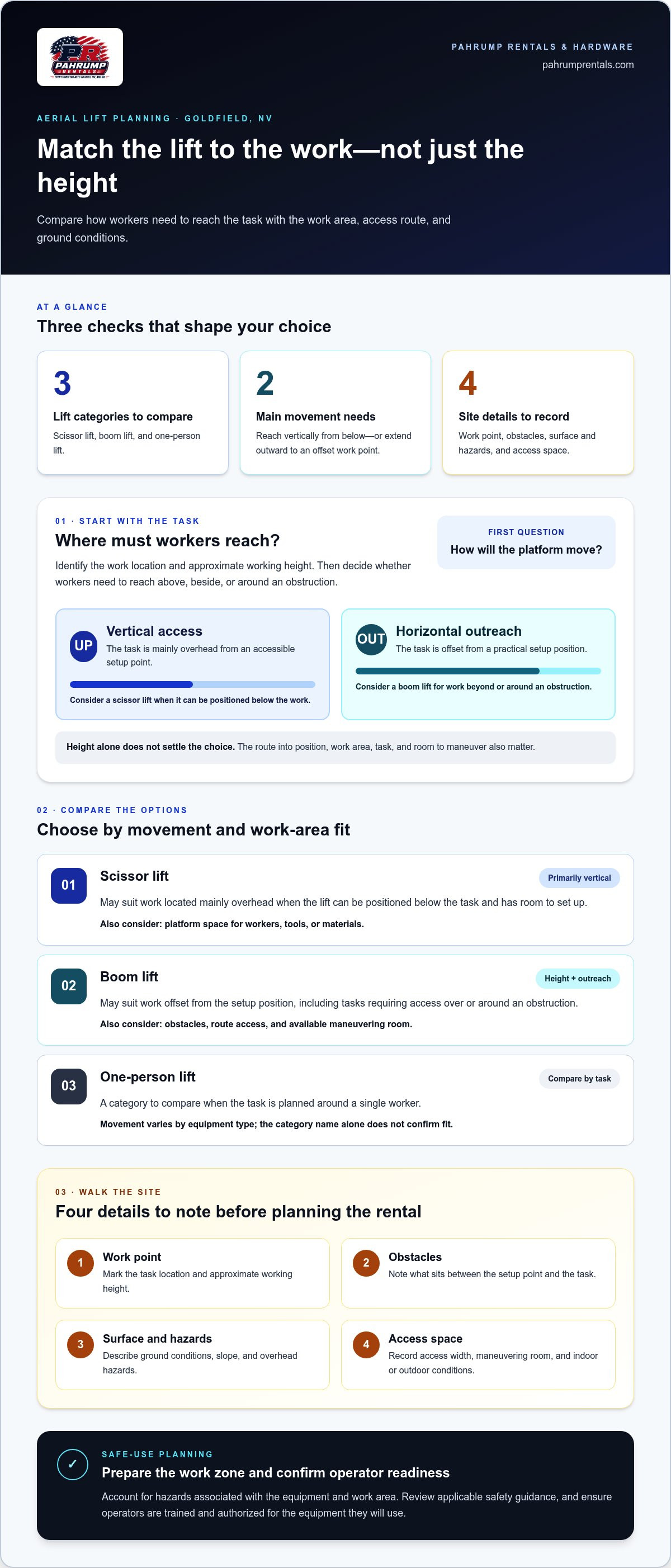
Then walk the route and setup area. Record the ground surface and slope, along with obstacles, overhead hazards, and available access routes. Note whether the work is indoors or outdoors and how much room there is to maneuver. A narrow entrance, confined setup area, or uneven surface can affect whether equipment can reach its intended position.
- Mark the work location and approximate height.
- Note obstacles between the setup point and the task.
- Describe ground conditions, slope, and overhead hazards.
- Record access width, maneuvering room, and indoor or outdoor conditions.
These practical details give the rental decision a reliable starting point and help connect equipment selection to how the work will actually be carried out at the Goldfield site.
Boom Lift or Scissor Lift? Understand the Main Aerial Lift Options
The main difference is how each lift positions workers. A scissor lift generally raises its platform vertically, while a boom lift can provide height and horizontal outreach. That distinction can help narrow the choice, but the work area, access path, and task still matter. For aerial lift rental Goldfield NV, compare how the platform needs to move with where workers will perform the job.
| Lift category | Movement | Work-area shape and access | Typical task fit |
|---|---|---|---|
| Scissor lift | Primarily vertical platform movement | Useful where the lift can be positioned below the work area and has room to set up | Tasks located mainly overhead from an accessible setup point |
| Boom lift | Raises workers and can extend outreach | May suit work offset from the setup position; obstacles and route access affect selection | Tasks requiring access over or around an obstruction |
| One-person lift | Varies by equipment type | Consider the work position and available access space | A category to compare for tasks planned around a single worker |
When does a scissor lift suit the work area?
A scissor lift may suit a task positioned mainly above an accessible setup area, where workers can bring the platform close to the work instead of reaching across from a distance. Consider what workers need to bring with them, such as tools or materials, and how much room the task requires. Platform space and movement needs affect whether workers can carry out the job efficiently.
When is boom-lift outreach important?
Outreach matters when the work point sits away from a practical setup position, such as beyond an obstruction or beside an area where the lift cannot stand directly beneath the task. The route into position, available maneuvering room, and obstacles around the work can all affect which boom configuration suits the job. Compare these site conditions with the task before choosing a rental category.
Height alone doesn’t settle the comparison. A high task may still call mainly for vertical movement, while another job may require workers to reach sideways to access the work point. A one-person lift is another broad category in the aerial equipment market, but its name alone doesn’t establish its fit for a particular task. Match the category to the required movement, work space, and access conditions rather than assuming all lifts solve the same problem.
Safe selection also means accounting for hazards associated with the equipment and work area. OSHA’s aerial lift safety guidelines provide information on lift hazards and safe use. Review applicable safety guidance as part of planning, and ensure operators are trained and authorized for the equipment they’ll use.
Once the category is clearer, connect it to the practical details of the rental plan. Pahrump Rentals & Hardware provides industrial equipment and tool rentals for Goldfield-area projects, helping you plan around the equipment your work requires.
Compare Aerial Lifts for Goldfield: Reach, Terrain, and Site Access
A lift has to reach the work point and get into a suitable position. For an aerial lift rental Goldfield NV, compare the height and outreach required with ground conditions, obstacles, and the route to the setup area. A machine’s height label alone won’t tell you whether it can work safely and effectively at your site.
Choose by the task’s actual reach and setup conditions, not height alone.
Required work height: Record the height of the work point and where the platform needs to be positioned. A platform-height label describes the platform’s elevation, while working height refers to the approximate height a worker can reach while standing on it. Check the equipment’s terminology and specifications when comparing options, since labels can vary.
Horizontal reach: Note whether the task is directly above a practical setup position or offset from it. Identify any walls, structures, equipment, or other obstacles between the machine and the work point.
Ground and slope: Describe the surface where the lift would travel and operate, including whether it’s firm, uneven, or sloped. Site conditions can affect which equipment category is suitable and where it can be positioned.
Obstacles and overhead hazards: Identify objects or structures around the work area, along with overhead hazards that may affect access or movement. Include changing outdoor conditions, such as weather, in the site review.
Access width and travel path: Measure gates, entrances, and other narrow points along the intended route. Consider turning and maneuvering space, not just whether equipment can pass through the widest opening.
How do you estimate the height and outreach required?
Locate the task, then identify a realistic place for the lift to stand. Estimate the vertical distance to the work point and whether the worker must reach sideways or around an obstacle. Keep platform height separate from the worker’s reach. A label doesn’t guarantee that the work point is accessible from every setup position, so compare the site layout with the equipment’s stated operating information.
How do ground and access affect aerial-lift selection?
Walk the planned travel route and setup area before settling on a category. A narrow gate, sloped ground, limited clearance, or soft or uneven surface can rule out an otherwise suitable setup. Include overhead hazards and outdoor weather conditions in the review. The more clearly you describe the route and operating area, the more accurately your equipment decision can reflect the site.
- Mark the work point and likely setup location.
- Note barriers, overhead hazards, and required outreach.
- Record ground conditions, slope, clearance, and route width.
- Compare these details with the relevant available equipment and product categories as you organize the project rental.
These checks bring reach, terrain, and access into one practical comparison. Use them to narrow the equipment category before planning the rental around the task and site.
Plan a Safe Aerial Lift Rental for a Goldfield Jobsite
A safe rental starts with a clear work plan. Before arranging an aerial lift rental Goldfield NV, map out the task, route, operating area, and conditions workers may face. This preparation connects the equipment choice to the site and gives the crew a shared plan before work begins.
Use this sequence to prepare:
- Define the task. Identify the work point, what workers will do there, how long the task is expected to take, and who needs access. These details help establish the lift category and planned work position.
- Inspect access and ground. Review the travel path, entrances, gates, clearance, slopes, and surface conditions. Note anything that could restrict movement or prevent the equipment from reaching its planned position.
- Identify hazards. Look for overhead obstructions, nearby activity, changing weather, and conflicts with people or other work. Include wind in the review, and follow the equipment’s instructions and site procedures for operating conditions.
- Plan the work zone. Set boundaries around the lift’s operating area so people not involved in the task stay clear. Consider where workers will enter, where materials may be staged, and how the area will remain controlled as work proceeds.
What should the jobsite review cover?
Check ground conditions and slope where the lift will travel and operate, then consider overhead obstructions and conflicts along the route. Define a controlled work area that keeps bystanders and other workers clear of the equipment’s operating zone. Record site-specific limits, such as restricted access, narrow passages, nearby work, or limited positioning space, so the plan reflects the actual site.
What should operators plan before work begins?
Only trained, authorized operators should use the equipment. Before starting, operators should review the equipment instructions and the training required for the specific lift. The employer is responsible for training, evaluating, and authorizing operators. Review applicable safety requirements and document site operating procedures as appropriate.
Weather deserves active attention, not a one-time glance. Wind can affect lift operation, so establish who will monitor conditions and what steps the crew will take if they change. Follow equipment guidance and site procedures, including a clear stop-work process. Don’t assume a task should continue simply because the lift is already positioned.
Plan rental logistics alongside the site review. Set the intended rental dates around the work sequence, and account for transport, arrival, setup, and return. Prepare the access route and work area before the equipment is scheduled to be used. The complete equipment rental guide for Pahrump offers broader context for organizing a project rental.
Coordinate the equipment plan with the task, site conditions, and work schedule. Pahrump Rentals & Hardware provides equipment rentals for projects in Goldfield and nearby communities.
Rent an Aerial Lift for Goldfield Work: Your Next Steps
A well-organized rental plan connects job requirements to the site and work schedule. For aerial lift rental Goldfield NV, gather project details before settling on a lift category or rental dates. This gives your rental planning a practical starting point and helps keep the equipment plan aligned with the task.
- Define the task. Describe what workers need to do, where the work point is, and how long the equipment is expected to be needed.
- Record the site conditions. Note approximate work height, horizontal outreach, ground surface, slope, overhead obstacles, access restrictions, and available maneuvering space.
- Identify the lift category. Compare the movement and access the task requires with the site setup, rather than choosing by height alone.
- Plan the dates. Set intended rental dates around the work sequence and allow time to prepare the work area and operators.
What project details help organize a rental?
Keep your notes together in one project summary. Include work height, outreach needs, surface and access constraints, expected task duration, and intended work dates. Add limits that could affect positioning or movement, along with the operator and work-zone plan. Contractors organizing recurring rental and procurement needs can use the contractor registration portal to manage their planning.
Clear notes help whether you’re coordinating one job or arranging equipment as part of a larger project schedule. They keep rental planning focused on the work itself, including how the lift will reach the task and fit the site. For additional contractor-planning context, see the contractor equipment rental guide.
How can Goldfield contractors take the next step?
Pahrump Rentals & Hardware provides industrial equipment and tool rentals for Goldfield and nearby Nevada communities, including Pahrump, Beatty, and Tonopah. Contractors can also use the dedicated portal to manage rental and procurement needs. Start with your project summary, then bring the task, site conditions, lift category, and schedule together in one plan.
Explore equipment rental options as you prepare for your Goldfield project.
Put Your Goldfield Lift Plan Into Motion
Turn your site notes into a short project brief your team can use. Include the task, planned work dates, access conditions, and who will operate the equipment. Keep the brief with your job schedule so equipment planning stays connected to the work sequence instead of becoming a last-minute decision.
That preparation gives your aerial lift rental Goldfield NV planning a clear starting point. Update the brief if the work area or schedule changes, and keep operator readiness and site procedures in the plan. A considered approach helps your crew share an understanding of what the job requires.
Pahrump Rentals & Hardware provides equipment and tool rentals, along with a contractor portal for rental and procurement management. Explore equipment rentals and plan your Goldfield project with your project details in hand.
Frequently Asked Questions
How do I choose the right aerial lift for a Goldfield project?
Start by describing the task and the worker’s position, then use those details to narrow the equipment category. For aerial lift rental Goldfield NV, a quick site sketch can help: mark the work point, possible setup locations, and anything between them. Add expected work dates and note whether workers need to carry tools or materials. This gives your rental planning concrete context beyond a requested height or machine name.
What is the difference between a boom lift and a scissor lift?
A scissor lift generally raises its platform vertically, while a boom lift can position it outward as well as upward. Work directly above a clear setup point may need a different movement pattern than a task beyond a fixed obstruction. Consider where workers must stand to complete the job and whether the lift can reach that position from a practical setup area.
How high can an aerial lift reach?
There isn’t one reach height that applies to every aerial lift. Equipment types and individual machine specifications differ, so compare the stated platform height with the task height and the worker’s needed reach. For a sloped roof edge or high fixture, identify the exact work point rather than estimating from ground level alone. Use the specific equipment documentation and operating guidance to assess the fit.
How much does it cost to rent an aerial lift in Goldfield, NV?
Rental pricing depends on the equipment category, rental period, and project requirements, so a generic online figure may not represent your job. Prepare the planned dates, task description, required work position, and site access notes when planning a rental. For example, noting restricted access gives more useful context than providing only a desired height. Keep the project details together to support clear planning.
Can an aerial lift be used on uneven ground?
Whether a lift can be used depends on the machine’s design, the surface, and its operating instructions. Uneven ground, soft areas, and slopes may affect stability or movement. Identify where the lift would travel and where it would be positioned while workers are elevated. Don’t assume that being able to drive across a surface means the equipment can operate there safely.
What should I check before operating a rented aerial lift?
Before use, make sure the operator is trained and authorized for the equipment, and review its instructions and required procedures. Walk through the work area with the crew so everyone understands the operating boundary and how to stay clear. Check for changes since the site was first assessed, such as new obstructions or shifting weather. If conditions differ from the plan, pause and reassess before continuing.
Does a boom lift or scissor lift work better for outdoor jobs?
Neither category is automatically the better choice outdoors. A task directly above a clear setup area may have different access needs from work beyond an obstacle. Outdoor conditions also make the travel surface and changing weather relevant to the decision. For projects in Goldfield, Pahrump, Beatty, or Tonopah, compare the actual work position and site limits with the equipment’s specifications instead of selecting by location or category alone.


