
A single sub-freezing night at 6,000 feet can drain an RV furnace far faster than most travelers anticipate. Finding reliable propane for RVs Tonopah travelers can count on is essential before setting out into the high desert. You already know that fuel and service stops grow sparse along the long US-95 corridor between Tonopah and Pahrump. When freezing temperatures drop over the basin, losing your primary heating source isn't merely an inconvenience; it puts your plumbing, your comfort, and your journey at risk.
This 2026 guide shows you how to select proper tank configurations, verify certified fittings, and plan seamless refill stops across Central Nevada without fuel anxiety. We'll clarify the practical differences between permanently mounted ASME tanks and portable DOT cylinders, explain strict station inspection standards, and highlight where to find dependable hardware and RV service support across Southern and Central Nevada.
Key Takeaways
- Distinguish between permanently mounted ASME tanks and portable DOT cylinders to ensure your setup meets strict high-desert refill compliance standards.
- Plan strategic refueling stops along US-95 to secure reliable propane for RVs Tonopah travelers rely on when facing rapid elevation and temperature changes.
- Discover why bulk fuel dispensing provides substantially greater capacity and cost efficiency than standard cylinder exchange kiosks.
- Protect your rig against road vibration and dry desert heat by inspecting LP lines, regulators, and date stamps before embarking across rural Nevada stretches.
- Stage your journey through established regional hubs offering heavy-duty RV supplies, professional hardware, and hands-on repair support.
Evaluating Propane Options for RVs Traveling Through Tonopah
Central Nevada’s high desert presents a unique challenge for traveling rigs. When you source propane for RVs Tonopah routes require, your rig's specific tank engineering determines how and where you can refuel. Commercial travel stops frequently focus on long-haul freight trucks, leaving motorhome and trailer operators to decipher dispensing layouts on their own. Knowing your setup before pulling up to a rural dispenser ensures smooth refueling without holding up traffic or risking a refused fill.
Permanently Mounted ASME Tanks vs. Portable DOT Cylinders
RV liquid petroleum systems fall into two distinct structural categories, each governed by different manufacturing standards and station clearance requirements:
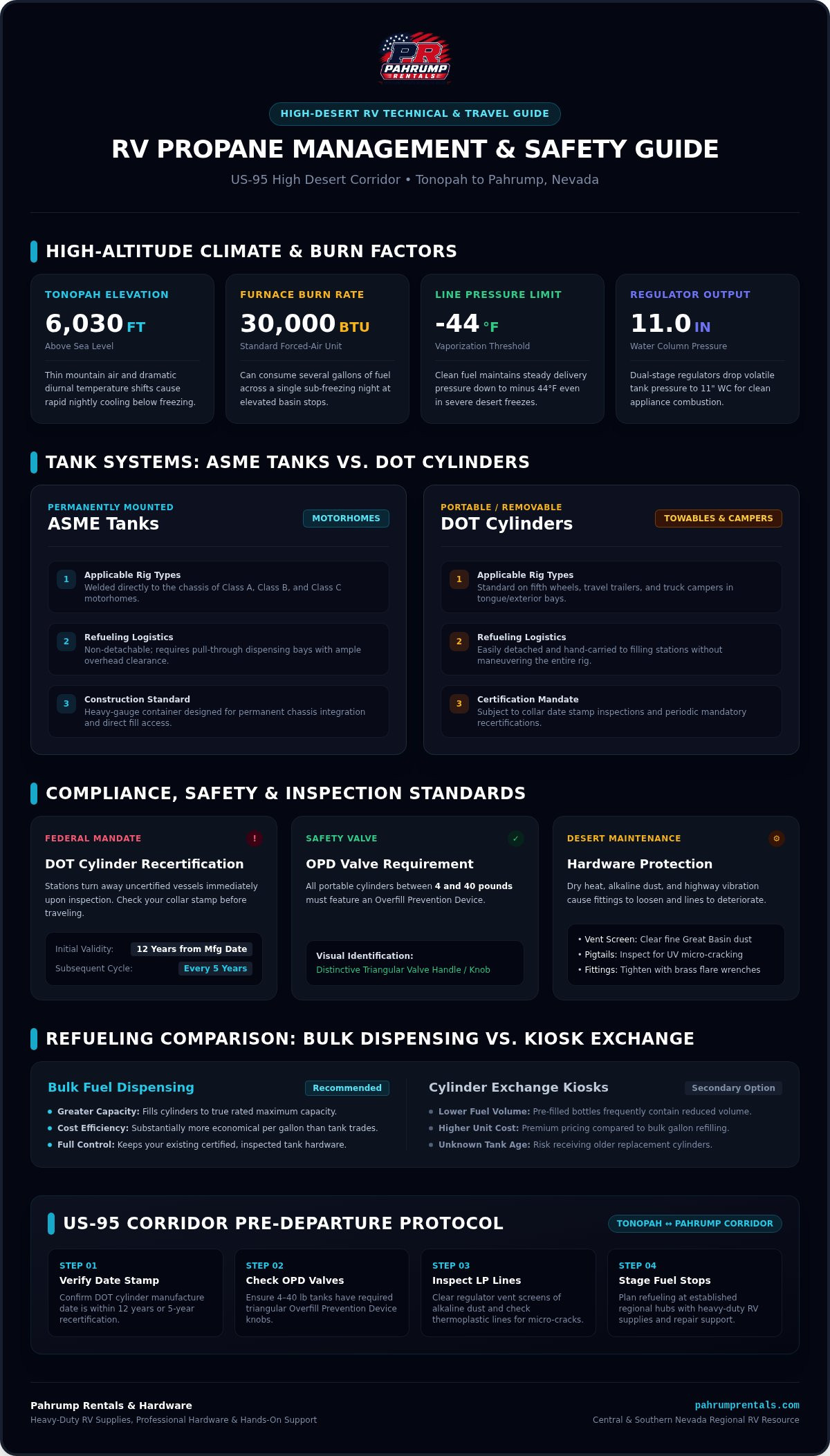
- ASME Tanks: Welded directly to the chassis of Class A, Class B, and Class C motorhomes, these heavy-gauge containers cannot be detached for filling. Dispensing technicians must access the fill valve directly on the rig, demanding wide overhead clearance and pull-through bays.
- DOT Cylinders: Standard on fifth wheels, travel trailers, and truck campers, these portable bottles sit in tongue brackets or exterior compartments. Because they detach easily, operators simply carry them to a filling station without maneuvering an entire tow setup through crowded lots.
Understanding this mechanical divide prevents logistical headaches. Finding proper propane for RVs Tonopah waypoints offer means confirming that a supplier can accommodate your physical vehicle footprint.
Propane Consumption Realities in Central Nevada Elevation
Sitting at roughly 6,030 feet above sea level, Tonopah experiences dramatic diurnal shifts. High-altitude air cools rapidly once the sun dips behind the desert ridges, frequently plunging night temperatures below freezing even during shoulder seasons. Because standard forced-air furnaces draw heavily under these conditions, a 30,000 BTU heating unit can consume several gallons of fuel across a single cold night.
Elevated terrain also affects fuel delivery. Clean propane fuel maintains steady line pressure down to minus 44 degrees Fahrenheit, but thin air requires clean appliance burner orifices to sustain complete combustion. Absorption refrigerators operating on gas mode struggle when elevation reduces air density, demanding a steady, contaminant-free supply to protect perishables.
Monitoring your burn rate before tackling long gaps across Central Nevada prevents unexpected depletion. Staging your fuel checks early keeps systems functional across rural highway stretches.
Essential RV Propane Equipment and Safety Standards for Desert Travel
Dry air, fierce sun, and washboard highway stretches take a heavy toll on exposed hardware. Securing safe propane for RVs Tonopah routes require involves more than pulling up to a nozzle; it demands sound delivery hardware beneath your rig. Unchecked line vibration and baking surface heat quickly turn small fitting imperfections into active hazards during remote desert travel.
Regulator Health and Two-Stage Pressure Requirements
Harsh conditions push dual-stage regulators to their limits. These components drop volatile tank pressure down to a steady 11 inches of water column, ensuring appliances burn cleanly despite intense afternoon heat. Fine alkaline dust from the Great Basin frequently clogs the lower vent, causing diaphragm lockups or erratic flame output.
- Check the downward-facing vent screen regularly to keep insects and fine dust from plugging internal seals.
- Inspect thermoplastic pigtail lines running from bottles to the main regulator for micro-cracks caused by UV exposure.
- Tighten inverted flare fittings with dedicated brass flare wrenches to prevent stripping soft metal threads under road stress.
Tank Certification, Recertification Dates, and OPD Valves
Federal regulations strictly dictate which containers technicians can legally fill. When planning a desert RV trip through rural highway corridors, check the collar stamp on your DOT cylinders before leaving town. Portable tanks require professional recertification 12 years after their manufacturing date and every 5 years thereafter. Stations will turn away uncertified vessels immediately.
Tanks between 4 and 40 pounds must feature an Overfill Prevention Device (OPD), identified by its unique triangular valve knob. If you discover weathered pigtails, faulty gauges, or outdated bottles during your pre-trip walkaround, you can source certified replacement hardware and specialty accessories from a dedicated hardware and tool supplier before heading into remote desert stretches.
Critical LP Gas Detectors and Leak Detection Protocols
Road chatter along rural highways can loosen plumbing connections behind appliances. Test your RV's hardwired interior LP detector monthly to verify sensor life and battery voltage. Most sensors require full unit replacement every five years to maintain factory sensitivity. Always use commercial bubble-leak solution on flared joints and connection unions rather than open flames. Finally, transport spare DOT cylinders securely upright in an open truck bed, never inside passenger quarters or unventilated vehicle cabins.
Refill Stations vs. Tank Exchange: Making the Cost-Effective Choice
RVers stocking up on fuel in Central Nevada usually choose between automated retail swap cages and professional bulk refill stations. When hunting for propane for RVs Tonopah routes require, that decision affects both your operating budget and your total heating reserve. Understanding the mechanical differences between these delivery methods helps you get every ounce of heat your rig needs on cold basin nights.
The True Economics of Bulk Gallons vs. Tank Swaps
Bulk dispensing stations measure product precisely by liquid gallon or scale weight, charging only for the fuel delivered into your container. Retail exchange kiosks, by contrast, charge flat convenience rates regardless of how much gas remained in your returned cylinder.
- Underfilled Cylinders: Pre-packaged exchange cages routinely stock standard 20-pound bottles filled to just 15 pounds of fuel. That missing 25 percent translates to roughly 1.2 fewer gallons of usable LP gas per bottle.
- Higher Net Fuel Cost: Because exchange services factor steel refurbishing, freight, and retail handling into their flat fees, exchanging can cost up to 73 percent more per pound of propane than refilling.
- Topping-Off Value: If your furnace consumed half a bottle during a chilly desert evening, a bulk station meters just the two gallons needed to restore capacity without penalizing you for leftover gas.
Review our comprehensive guide to propane refills for RVs and homes for a deeper operational breakdown.
When Quick Tank Exchanges Make Practical Sense
Bulk pumping clearly delivers superior value, but retail exchange lockers have their place under specific travel circumstances. If you arrive late at a closed outpost with depleted heat, an automated cage provides immediate relief without waiting for daytime staff.
Swapping also offers a clever workaround for aging steel. If a DOT cylinder approaches its 12-year expiration mark or shows heavy surface pitting, trading it at an exchange station effectively replaces an outdated bottle without paying separate recertification fees. Just examine the replacement cylinder's collar before accepting it. Ensure the collar date stamp is current, the valve features a triangular OPD knob, and the protective collar remains straight and intact.
Remember that motorized rigs with permanent ASME chassis tanks cannot utilize exchange kiosks. For these coaches, reliable propane for RVs Tonopah travelers rely on must come from drive-up bulk pumps equipped with appropriate hoses and nozzle clearances.
How to Plan Your RV Propane Route Along the US-95 Corridor
Traveling US-95 across Central Nevada requires deliberate route planning. The highway connects scattered high-desert basins across vast expanses of open public land, where fuel stations sit dozens of miles apart. When securing propane for RVs Tonopah bound travelers need, calculating your supply before climbing into high-elevation plateaus prevents cold nights and unnecessary detours.
Mapping Refill Checkpoints: Tonopah, Goldfield, Beatty, and Pahrump
Navigating this corridor smoothly depends on knowing where services concentrate. Each major waypoint along the route serves a specific role for regional travelers:
- Pahrump: Positioned south of the main corridor, Pahrump serves as the primary staging depot for regional travel. It provides extensive bulk dispensing, mechanical RV repair capabilities, and complete hardware inventories.
- Beatty: Situated 73 miles north of Pahrump, Beatty provides a critical refueling stop for rigs crossing the Amargosa Desert or staging excursions into Death Valley.
- Goldfield: This historic town features minimal commercial utility support, making it an unreliable option for bulk fuel dispensing.
- Tonopah: Anchoring the northern end of this corridor, Tonopah provides essential fuel infrastructure before travelers push farther toward Reno or disperse into remote boondocking sites.
Elevation climbs steadily as you travel north, rising from roughly 2,700 feet in Pahrump to over 6,000 feet in Tonopah. This climb brings steep temperature drops, so fill both DOT cylinders or your motorhome chassis tank completely before setting up camp on high plateaus.
Pre-Trip Rig Inspection and Safe Fueling Checkpoints
Maneuvering large fifth wheels, toy haulers, and Class A motorhomes into rural dispensing stations requires vigilance. Always verify swing clearance around bollards and overhead canopies before pulling up to bulk tanks. Follow this direct four-step safety checklist at every stop:
- Step 1: Extinguish all open flames, shutting off interior water heater controls, absorption refrigerators, and furnace thermostats.
- Step 2: Turn the primary gas shutoff handwheel completely clockwise to seal line pressure at the container.
- Step 3: Evacuate all passengers and family pets from inside the living space until dispensing finishes completely.
- Step 4: Confirm the attendant has closed the 80-percent bleeder valve and detached the fill hose before turning your ignition key.
Planning these stops methodically ensures your supply of propane for RVs Tonopah routes require remains dependable. Before pulling onto the highway, stock up on critical travel fittings and RV supplies to keep your mechanical systems running smoothly throughout the desert.
Choosing Pahrump Rentals & Hardware for Dependable RV Support
Large interstate plazas focus on swift turnarounds, rarely carrying the specialized components needed when desert conditions strain an RV's mechanical systems. Sourcing propane for RVs Tonopah routes demand is only one element of a successful high-desert journey. Having an independent partner with deep regional roots ensures you have access to both bulk fuel and hands-on mechanical expertise before tackling isolated stretches of US-95.
Comprehensive RV Supplies and Hardware Solutions
Harsh conditions demand durable parts. Standard consumer accessories often fail under the punishing washboard surfaces and extreme thermal swings of Southern and Central Nevada. Maintaining system integrity requires heavy-duty fittings and certified replacement assemblies.
- Corrosion-Resistant Fittings: Flare unions, heavy brass tees, and seamless copper tubing resist vibration damage far better than lightweight alternatives.
- Industrial Fasteners: High-grade bolts, lock washers, and structural brackets keep exterior tank trays and undercarriage LP lines firmly anchored over rugged terrain.
- Field Equipment: Access specialized fittings and safety gear through our local equipment inventory to ensure your setup meets strict dispensing standards.
Staging your trip with industrial-grade hardware prevents small mechanical failures from escalating into travel delays when services disappear on the horizon.
Professional RV Repair and Corridor Peace of Mind
Propane appliances rarely fail in isolation. Heavy road vibration between Beatty and Tonopah can shake electrical igniters out of alignment, bind mechanical slide mechanisms, or loosen water lines adjacent to your furnace enclosure. Commercial fuel stops lack the facilities to diagnose these cascading failures.
Our dedicated service center delivers full mechanical support to regional travelers. Review our guide on comprehensive RV repair in Pahrump to see how our team handles everything from electrical diagnostics to slide-out realignments. Rather than leaving travelers stranded with a non-functioning furnace or leaking regulator, our technicians troubleshoot underlying mechanical faults alongside routine propane dispensing.
Independent regional expertise makes the difference between an interrupted journey and a confident expedition. Setting out with verified systems and dependable local backing lets you explore Central Nevada with absolute certainty.
Equip Your Rig for the Open Basin Highways
Traversing Central Nevada requires proactive preparation long before your tank levels dip. Managing propane for RVs Tonopah routes require involves matching your vehicle footprint to bulk dispensing stations, monitoring high-elevation burn rates, and maintaining durable brass hardware against desert vibration. Taking time to inspect regulator vent screens and tank certification dates ensures your appliances perform safely through freezing high-desert nights.
When you need reliable support across Nye and Esmeralda counties, local expertise provides total confidence on the road. Pahrump Rentals & Hardware maintains a comprehensive inventory of heavy-duty RV supplies, structural fasteners, and certified gas fittings alongside full-service RV repair capabilities. Visit Pahrump Rentals & Hardware for dependable RV propane, hardware, and repair services before you head north. Travel with confidence knowing your rig is fully equipped to handle every mile of the desert journey ahead.
Frequently Asked Questions
Can I legally travel with my RV propane valve open along US-95?
Yes, it is legal to drive with your RV propane valve open along US-95 in Nevada. Federal and state regulations do not prohibit operating LP systems on open highways, allowing two-way refrigerators to stay cold while driving. However, you must shut the main container valve completely before entering commercial fuel dispensing islands. Many travelers also choose to turn valves off during travel as an added precaution against roadway debris impacts.
How do I know whether my RV has an ASME or DOT propane tank?
Check how the container mounts to your vehicle and inspect its identification plate. ASME tanks are permanently bolted or welded beneath motorized Class A, B, or C chassis and feature a riveted steel specification plate. DOT cylinders sit in exterior brackets or tongue mounts on travel trailers, detach easily by hand, and have manufacturing dates and pressure ratings stamped directly into the protective steel collar surrounding the valve.
What should I do if my RV propane regulator freezes during cold Tonopah nights?
Never apply an open flame or torch to a frozen regulator body. External frost usually indicates heavy fuel vaporization causing sudden temperature drops, or moisture trapped inside contaminated gas lines. Turn off appliances, close the tank valve, and warm the regulator housing gently using warm water or an electric heating pad. If freezing persists, you need fresh, clean propane for RVs Tonopah suppliers provide and an unclogged vent screen.
Why do bulk refill stations charge less per pound than cylinder exchanges?
Bulk stations meter liquid fuel directly into your container, charging strictly for the exact gallons pumped. Retail exchange cages bill a flat convenience fee that absorbs corporate shipping costs, packaging, and tank refurbishing. Exchange cages also routinely pack standard 20-pound bottles with only 15 pounds of fuel. Buying metered gallons from an established bulk supplier ensures you receive full capacity without paying inflated retail premiums for pre-filled steel.
How often do portable RV propane tanks require recertification?
Portable DOT cylinders require professional recertification 12 years after their original manufacturing date stamped on the collar. Following that initial 12-year window, tanks must undergo inspection and recertification every 5 years to remain legally fillable at commercial dispensers. Qualified attendants along the US-95 corridor will inspect these stamped dates and check for mandatory triangular Overfill Prevention Device valves before connecting a dispensing hose to your rig.
Where can I buy replacement propane fittings and hoses between Tonopah and Pahrump?
Pahrump Rentals & Hardware stocks a dedicated inventory of brass adapters, pigtails, dual-stage regulators, and heavy-duty RV supplies. While isolated outposts along US-95 offer limited convenience items, finding specialized LP gas plumbing and complete RV repair requires staging through dedicated regional suppliers. Securing proper fittings and dependable propane for RVs Tonopah travelers count on before heading north prevents mechanical delays in remote mining towns.
Will running my RV furnace drain a 20-pound propane tank overnight in the desert?
A typical RV furnace will not empty a full 20-pound tank in a single night, but it can consume half its capacity. A standard 30,000 BTU furnace burns roughly one-third of a gallon of propane per hour of continuous operation. During sub-freezing basin nights where the heating unit cycles frequently, expect to burn two to three gallons. Partially filled exchange bottles risk running dry before morning.


