
Could a bolt that looks almost right still leave a joint loose or fail to fit? If you’re searching “metric bolts and nuts Pahrump,” start by matching the fastener to the job, not by guessing from appearance. Metric and inch-size hardware can look similar, but diameter and thread pitch determine whether the parts fit together properly.
Choosing a fastener can feel uncertain when a project calls for a specific size, material, or strength. This guide explains how to identify the dimensions you need and select hardware suited to the assembly and its working conditions. It also outlines a practical local purchasing process, starting with Pahrump Rentals & Hardware, a local independent business that offers professional hardware solutions and a wide variety of fasteners.
Use the steps below to read common metric sizing, identify what to consider before selecting material and strength, and prepare for a more focused hardware purchase. Whether you’re working on a repair, a build, or a contractor project in Pahrump, Beaty, Goldfield, or Tonopah, accurate details help you avoid relying on guesswork.
Key Takeaways
- Record a fastener’s diameter, thread pitch, and under-head length to identify the dimensions your project requires.
- Use existing markings and equipment documentation to help identify strength requirements. Don’t rely on appearance alone.
- Metric and inch-size fasteners can look similar, but their threads may not match. Check the measurement system and thread details before fitting parts together.
- For metric bolts and nuts Pahrump projects, bring measurements, quantity, and equipment references to make a local hardware purchase more straightforward.
- Pahrump Rentals & Hardware serves local projects with professional hardware solutions and a wide variety of fasteners.
Metric Bolts and Nuts in Pahrump: What Buyers Need to Know First
Replacing hardware or assembling parts can seem simple until a new bolt won’t thread smoothly into the nut or existing hole. The right match depends on more than the bolt’s apparent thickness. For metric bolts and nuts Pahrump shoppers, identifying a few key details can prevent a poor fit and help keep the selection aligned with the project requirements.
Metric bolts and their matching nuts are threaded fasteners specified using metric dimensions. They’re used in equipment repair, mechanical assemblies, and other projects where the design calls for metric hardware. When replacing a fastener, start with the original part or project documentation instead of choosing by visual resemblance.
What makes a bolt and nut metric?
Metric sizing uses millimetres to describe a bolt’s nominal diameter and length. Thread pitch is a separate measurement: it’s the distance between adjacent thread peaks. The nut must match the bolt’s diameter and pitch so the threads engage correctly. The ISO metric screw thread reference explains the system and its designations.
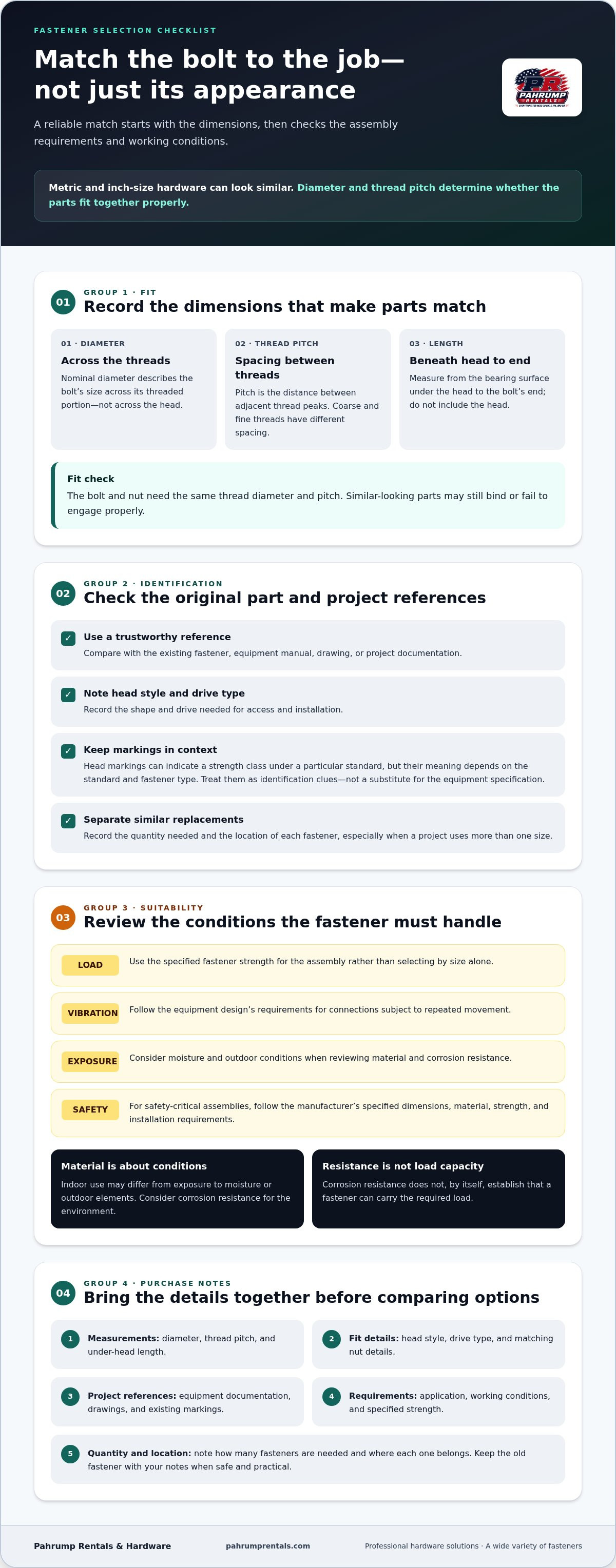
Nominal diameter describes a bolt’s size across its threads, thread pitch measures the spacing between those threads, and bolt length measures the fastener from beneath its head to its end.
Which details should you identify before shopping?
Use the existing fastener as a reference when possible, or consult the equipment manual, drawing, or project documentation. Record the details that affect fit and suitability:
- Diameter and pitch: Identify the thread size and spacing.
- Length: Measure from beneath the head to the bolt’s end.
- Head style: Note the shape and drive type needed for access and installation.
- Application: Record what the fastener connects, along with relevant equipment references or existing markings.
Keep the old fastener with your notes if it’s safe and practical to remove. Record the quantity needed and the location of each fastener as well. This makes it easier to distinguish similar-looking replacements when a project uses more than one size.
Accurate details make a local hardware purchase more efficient. Pahrump Rentals & Hardware serves the Pahrump community with professional hardware solutions and a wide variety of fasteners. You can explore the store’s fastener and hardware products as you prepare for your project. Bring measurements and documentation so you can focus on the job’s requirements rather than guessing from appearance.
Metric Bolt and Nut Specifications: Match Size, Thread, and Strength
A fastener can appear to fit and still be wrong for an assembly. Selecting a suitable replacement means matching its dimensions and understanding the conditions it must handle. For metric bolts and nuts Pahrump projects, refer to equipment documentation or the original fastener, especially when a connection carries a load or is safety-critical.
How do diameter, pitch, and length affect fit?
Measure the bolt’s nominal diameter across the threaded portion, not the head. Thread pitch is the spacing between adjacent thread peaks. Measure bolt length from the bearing surface beneath the head to the end, since including the head can give you the wrong result. Record each measurement and compare it with the equipment specification or original fastener.
Coarse and fine threads have different spacing. Neither is automatically right for every project. The required pitch depends on the design and the matching nut. A correct fit requires the bolt and nut to share the same thread diameter and pitch. Similar-looking parts can still bind or fail to engage properly.
How should material and strength influence selection?
Choose material and strength according to the assembly’s requirements and exposure. A fastener used indoors may face different conditions from one exposed to moisture or outdoor elements. Corrosion resistance addresses how a fastener withstands its environment. It doesn’t, by itself, establish that the fastener can carry the required load.
Some fasteners carry head markings that indicate a strength class under a particular standard. Treat those markings as identification clues, not as a substitute for the equipment specification. Their meaning depends on the applicable standard and fastener type, so don’t assume that an unfamiliar mark guarantees suitability.
Before choosing a replacement, consider the working conditions:
- Load: Use the specified fastener strength for the assembly rather than selecting by size alone.
- Vibration: Follow the equipment design’s requirements for connections subject to repeated movement.
- Exposure: Consider moisture and outdoor conditions when reviewing material and corrosion resistance.
- Safety: For safety-critical assemblies, follow the manufacturer’s specified dimensions, material, strength, and installation requirements.
A stronger-sounding label or a corrosion-resistant finish doesn’t make an unspecified fastener a safe substitute. Keep the equipment reference and any markings together when comparing replacement options. This gives the selection a clear basis and helps distinguish a true match from a part that only looks similar.
Pahrump Rentals & Hardware offers professional hardware solutions and a wide variety of fasteners for local projects. Once you’ve documented the required specifications, review the store’s fastener and hardware products as part of planning your purchase.
Metric vs. Inch-Size Fasteners: Avoid Fit and Compatibility Problems
A metric bolt and an inch-size bolt can look nearly identical on a workbench, but appearance doesn’t show whether their threads will mate. This matters during equipment repair and assembly: forcing a mismatch can damage the bolt, nut, or threaded hole. Before replacing hardware, confirm the measurement system and specifications in the equipment documentation.
| What to check | Metric fastener | Inch-size fastener |
|---|---|---|
| Diameter and length | Specified in millimetres | Specified in inches or fractions of an inch |
| Thread description | Metric designation, often shown with an M and dimensions | Inch-based thread designation, which may include threads per inch |
| Documentation cues | Look for metric dimensions, an M designation, or metric references in the manual | Look for inch or fractional dimensions and inch-thread descriptions |
Can an inch-size bolt replace a metric bolt?
Not just because the diameters seem close. Threads can differ in pitch, or spacing, as well as in their measurement system. A nut that starts to turn may still be mismatched. Forcing it can cross-thread the connection, leave it loose, or damage components and make a later repair more difficult.
Confirm the required system, diameter, pitch, and length against the equipment manual or original fastener before substituting. Don’t rely on a rough conversion or a bolt that appears to fit.
What information helps distinguish the two systems?
Start with manufacturer documentation, labels, drawings, and markings on the original hardware. An M designation can indicate a metric thread description, while inch-size documentation may state a fractional diameter or threads per inch. Markings provide useful clues, but identify the full specification rather than relying on a single character.
Calipers can help compare diameter and length, and a thread gauge can help identify pitch. Measuring diameter alone won’t establish thread compatibility. For example, a manual that specifies a metric bolt with a particular pitch provides more useful identification than a visual estimate of its width. It does not make a nearby inch-size fastener interchangeable.
If a replacement won’t engage smoothly by hand, stop. Back it out rather than tightening through resistance, then recheck the system, thread pitch, and equipment reference. This pause can help protect both the fastener and the part it threads into.
For metric bolts and nuts Pahrump projects, accurate identification helps keep a local hardware purchase focused on the right requirements. Pahrump Rentals & Hardware serves local projects with professional hardware solutions and a wide variety of fasteners. Use documented specifications to guide your selection, and review the store’s fastener and hardware products as you plan your purchase.
How to Choose Metric Bolts and Nuts for a Pahrump Project
A reliable selection process starts with the job, then checks fastener details against the project requirements. This helps DIYers and contractors avoid mixing similar parts and keeps the choice grounded in the equipment or assembly specifications. For metric bolts and nuts Pahrump projects, record what you know and keep each fastener type organized from inspection through final fit.
A practical fastener identification checklist
Inspect the original fastener and assembly before shopping. Use manuals, diagrams, or manufacturer markings to identify specified material and strength rather than guessing from appearance. If you’re removing several fasteners, sort them by location or type and label each group so measurements and quantities don’t get mixed up.
- 1. Identify the application. Note what the fastener joins, which equipment or assembly it belongs to, and whether it has a safety-critical role.
- 2. Check references. Review the manual, parts diagram, or manufacturer information for the required fastener system and specifications.
- 3. Record dimensions. Measure diameter, thread pitch, and length, and note the head style. Keep the measurement points clear in your notes.
- 4. Capture identifying details. Write down visible markings and any documented material or strength requirements.
- 5. Assess working conditions. Consider expected load, vibration, indoor or outdoor exposure, and maintenance conditions. Treat these as selection factors, not as a reason to assume a particular fastener specification.
- 6. Confirm quantity and fit. Count the fasteners needed for each location. Check that a replacement matches documented requirements and fits correctly without forcing it.
What should local DIYers and contractors consider?
Use the project’s documented requirements as your deciding reference, whether you’re repairing equipment, replacing hardware, or assembling components. For outdoor work in Pahrump, Beaty, Goldfield, or Tonopah, consider the fastener’s exposure and likely maintenance conditions, but don’t choose a material based on location alone. The assembly’s specified load and strength requirements still matter.
A simple record can make local purchasing more efficient. Write down each fastener’s location, dimensions, quantity, markings, and equipment reference. If several types are involved, use separate labeled bags or notes. This helps prevent a replacement intended for one connection from being confused with hardware from another.
Contractors managing recurring hardware and rental procurement can use the contractor registration portal to support their purchasing workflow. For a one-time repair or project, bring organized measurements and equipment references when sourcing hardware locally. Clear information connects the job’s requirements with the right fastener selection.
Find Metric Bolts and Nuts Locally in Pahrump
A prepared set of measurements makes a local hardware purchase more focused. Rather than trying to identify a fastener from memory, bring details that connect the replacement to the equipment or assembly. For metric bolts and nuts Pahrump projects, clear information helps guide selection while keeping the project’s documented requirements at the center.
What to bring when sourcing fasteners in Pahrump
If it’s safe and practical, bring the original fastener as a reference. Otherwise, bring your measurements and a photo that clearly shows the fastener and any markings. Equipment documentation, such as a manual or parts diagram, can clarify specified dimensions and requirements.
Before you head out, organize these details:
- Fastener measurements: Record diameter, thread pitch, length, and head style, noting how each measurement was taken.
- Matching hardware: Include the nut requirements and whether the replacement must match an existing bolt or assembly.
- Project context: Summarize the application, expected load, vibration, and whether the fastener will face outdoor exposure or other relevant conditions.
- Quantity and references: Count the number needed for each fastener type and bring equipment information or a readable photo of existing markings.
Keep different fasteners separated and label notes by location or purpose. For example, if a repair uses more than one size, pair each measurement with its equipment location to avoid confusion during selection. Don’t rely on a photograph alone for dimensions. Use it alongside measurements and documentation.
A straightforward local purchasing path
With those details in hand, you can describe the project in terms of its actual hardware requirements. Pahrump Rentals & Hardware is a local independent business serving the Pahrump community with professional hardware solutions and a wide variety of fasteners. The aim is to connect accurate identification with a practical local purchase, without treating a similar-looking fastener as an automatic substitute.
For contractors coordinating hardware and rental procurement, the contractor registration portal supports procurement management. Individual project needs can be organized with a simple record of measurements, quantity, application, and equipment references. Keep that information accessible so the requirements remain clear from selection through installation.
Before fitting a replacement, compare it with the documented specifications and make sure the threads engage properly without force. A careful fit check can catch a mismatch before the hardware is put into service. Explore professional hardware products at Pahrump Rentals & Hardware for your project’s hardware and fastener needs.
Make Your Next Hardware Purchase More Confident
A dependable fastener choice can also make future maintenance easier. Keep a project record with the equipment reference and the specifications used, then update it if the assembly changes. That gives you a useful starting point when a repair calls for a replacement and helps prevent uncertainty from building back up.
For your next search for metric bolts and nuts Pahrump, put those project notes to work with a local hardware resource. Pahrump Rentals & Hardware serves Pahrump and nearby communities, including Beaty, Goldfield, and Tonopah, with professional hardware solutions and a wide variety of fasteners for repairs and project needs.
Explore professional hardware products at Pahrump Rentals & Hardware and plan your purchase with the job’s requirements in view. Browse hardware products and take your measurements, quantity, and equipment references with you to make the selection process more focused.
Frequently Asked Questions
How do I identify the size of a metric bolt?
Check the equipment manual or parts diagram first, since it may give the specified fastener dimensions directly. If those aren’t available, inspect the bolt for markings and measure the threaded diameter and length with suitable measuring tools. A thread gauge can help identify pitch. Keep measurements separate from estimates based on appearance, and note the bolt’s head style so you can compare the full part rather than just its width.
Are metric bolts and nuts interchangeable with inch-size fasteners?
No. Don’t assume an inch-size fastener can replace a metric one, even if their diameters look close. Thread spacing and form may differ, preventing a secure match. A nut that catches briefly can still cross-thread or damage the bolt or receiving component. Use the equipment specification to identify the required measurement system, then compare thread details before installing a replacement. Never tighten a mismatched fastener to make it fit.
How do I measure metric bolt thread pitch?
A metric thread-pitch gauge is a practical way to compare the bolt’s threads against marked leaves until one seats evenly. If you don’t have a gauge, measure a run of threads carefully and divide the distance by the number of gaps between thread peaks. Count the gaps, not just the peaks. Compare your result with equipment documentation, since a measurement alone may not identify the required specification.
What does the marking on a metric bolt head mean?
Head markings can identify a fastener’s strength class or manufacturer, depending on the fastener and applicable standard. Treat them as clues, not a complete selection guide: a mark doesn’t tell you whether the bolt has the correct dimensions or suits the assembly. Record the marking and compare it with the equipment documentation. If a safety-critical part is involved, follow the manufacturer’s specified fastener requirements.
Can I reuse a metric nut with a replacement bolt?
Sometimes, but only if the nut remains in good condition and the equipment instructions allow reuse. Check its threads for damage, contamination, corrosion, or deformation, and make sure it turns smoothly on the correctly matched bolt. Some locking nuts are intended for limited reuse or replacement according to manufacturer guidance. If the nut’s type or condition is uncertain, don’t treat it as reusable by default.
Which metric bolt material is best for outdoor use?
There isn’t one material that’s best for every outdoor assembly. Moisture and other exposure can make corrosion resistance important, but the fastener must also meet the connection’s load and strength requirements. A corrosion-resistant material isn’t automatically suitable for a load-bearing application. Check the equipment documentation for the specified material and strength, and consider the actual exposure and maintenance conditions before choosing a replacement.
Where can I buy metric bolts and nuts in Pahrump?
Pahrump Rentals & Hardware is a local source for professional hardware solutions and a wide variety of fasteners. For metric bolts and nuts Pahrump projects, bring the original fastener when practical, or note its measurements, markings, and equipment reference to make your purchase more focused. The business serves Pahrump and nearby communities, including Beaty, Goldfield, and Tonopah. Explore the store’s hardware products for your project needs.


