
The gear that protects a crew on a Pahrump job depends on the task, the hazards, and the person wearing it. A hard hat, respirator, or pair of boots must suit the specific exposure and fit correctly. Choosing safety equipment for construction Pahrump projects also means accounting for desert heat, intense sun, blowing dust, and uneven ground.
A standard kit can leave important risks unaddressed or make long shifts harder than necessary. Nevada’s heat illness prevention regulation and OSHA’s construction PPE fit rule make job planning and proper fit especially important.
This guide explains how to build a task-based checklist, compare fit, visibility, and durability, and account for the conditions workers will face. It also covers how to coordinate safety planning with equipment selection and contractor procurement. Pahrump Rentals & Hardware supports local projects with industrial equipment and tool rentals, professional hardware solutions, fasteners, and a contractor portal for managing procurement needs.
Key Takeaways
- Start with the job, its hazards, and existing safeguards before choosing protective gear.
- Match head, eye, hearing, hand, foot, respiratory, and visibility protection to each task, then check fit and condition.
- Compare protection, comfort, visibility, durability, and maintenance to avoid unsuitable or unnecessary gear.
- Use a pre-job checklist to account for Pahrump heat, sun, dust, visibility, and footing, then reassess as conditions change.
- Plan safety equipment for construction Pahrump projects alongside equipment rentals and hardware procurement through local project resources.
Safety Equipment for Construction in Pahrump: Start with the Jobsite Hazards
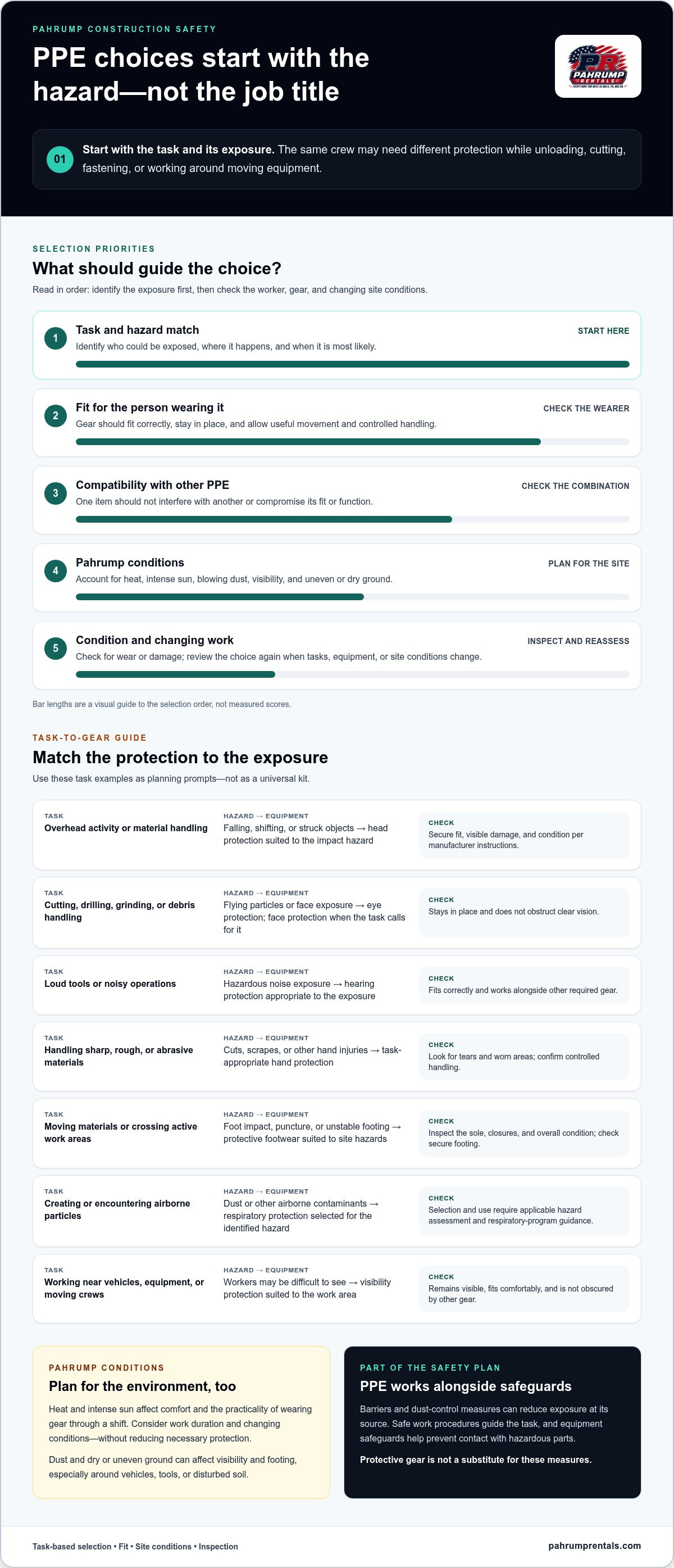
Identify the task and its hazards before selecting protective equipment. The same crew may face different risks while unloading materials, cutting, fastening, or working around moving equipment. A standard gear list may not cover every phase of a project.
Task-based PPE selection means choosing protective equipment to match the hazards, work activity, and conditions each worker will encounter. PPE protects the person wearing it, but it is only one part of a safe work plan. Engineering controls, such as barriers or dust-control measures, can reduce exposure at its source. Safe work procedures guide how a task is performed, while equipment safeguards help prevent contact with moving or hazardous parts. These measures work together. Protective gear should not be treated as a substitute for them.
How to identify hazards before choosing construction PPE
Before work begins, review each task and note who could be exposed, where the exposure occurs, and when it is most likely. Consider impact from falling or shifting materials, cuts from sharp edges, noise from tools, airborne particles from cutting or disturbance, and visibility around vehicles or equipment. This review helps match protection to the actual work rather than assumptions based on a job title.
Some hazards are routine for a task; others emerge as the site develops. A new cutting operation, a delivery moving through the work area, or a change in the crew’s location can alter exposure. Reassess when the work sequence, equipment, or site conditions change. Readers new to PPE can also review this broad Personal Protective Equipment overview for background on common protective categories.
Why Pahrump conditions affect equipment choices
In Pahrump, intense sun and heat belong in the job plan alongside task-specific hazards. They can affect worker comfort and the practicality of wearing gear through a shift, but they are not reasons to reduce necessary protection. Consider how each item fits, allows useful movement, and works with other gear worn at the same time. Heat planning should also account for work duration and changing conditions.
Dust and dry ground may affect visibility and footing, particularly when vehicles, tools, or disturbed soil are part of the work area. Consider whether workers can see one another clearly and move securely around the site. Uneven terrain, exposed materials, and shifting work zones can change which protections are appropriate as the project progresses.
A useful starting point for safety equipment for construction Pahrump projects is a brief, task-by-task hazard review. Repeat the review whenever the work or site conditions change.
Which Construction Safety Equipment Fits Each Task?
Choose protection according to the exposure, not just the job title. PPE must match the hazard identified for the task and the worker who will perform it. The categories below are planning prompts, not a universal kit. A worker may need different protection as tasks or site conditions change. OSHA’s construction safety standards and PPE guidance can help employers review applicable requirements and responsibilities.
| Task or exposure | Hazard to consider | Equipment category | Fit or inspection check |
|---|---|---|---|
| Working beneath overhead activity or handling materials | Impact from falling, shifting, or struck objects | Head protection suited to the identified impact hazard | Check secure fit, visible damage, and condition according to the manufacturer’s instructions. |
| Cutting, drilling, grinding, or handling debris | Flying particles or potential face exposure | Eye protection, with face protection where the task calls for it | Confirm the equipment stays in place and does not obstruct clear vision. |
| Operating loud tools or working near noisy operations | Hazardous noise exposure | Hearing protection appropriate to the exposure | Check that it fits correctly and can be used alongside other required gear. |
| Handling sharp, rough, or abrasive materials | Cuts, scrapes, or other hand injuries | Task-appropriate hand protection | Look for tears and worn areas, and check that the fit allows controlled handling. |
| Moving materials or walking across active work areas | Foot impact, puncture, or unstable footing | Protective footwear suited to the site hazards | Inspect the sole, closures, and overall condition; check that footing feels secure. |
| Creating or encountering airborne particles | Dust or other airborne contaminants | Respiratory protection selected for the identified hazard | Selection and use require applicable hazard assessment and respiratory-protection program guidance. |
| Working near vehicles, equipment, or moving crews | Workers may be difficult to see | Visibility protection suited to the work area | Check that it remains visible, fits comfortably, and is not obscured by other gear. |
Check fit, compatibility, and condition
Protective items need to fit each worker and work together. Eye protection should not interfere with head protection, and hearing or respiratory equipment should not be compromised by poor fit or incompatible gear. Before use, inspect reusable equipment for damage, wear, and manufacturer limits. Follow the manufacturer’s instructions for care and replacement. Disposable items, reusable gear, and task-specific equipment have different use and maintenance needs, so include those requirements in the work plan.
A practical safety equipment for construction Pahrump selection process starts with the task and ends with a fit and condition check. For related project equipment and hardware planning, browse equipment and hardware options.
How to Compare Construction Safety Equipment Without Overbuying
Buying more gear does not automatically make a jobsite safer. Select equipment that addresses identified hazards without adding items that do not fit the task, interfere with other protection, or go unused. For safety equipment for construction Pahrump projects, compare each option with the work and the conditions crews will face, rather than choosing by appearance or initial price alone.
A low purchase price does not show that an item is suitable or will remain serviceable. Review its intended use, durability, care requirements, and replacement guidance. A more comfortable item may support consistent use, but comfort cannot replace the necessary level of protection.
Which specifications and standards should buyers review?
Start with the manufacturer’s label and instructions. Check the stated intended use, limitations, sizing, cleaning directions, and any standard or approval identified on the product. OSHA and Nevada OSHA requirements depend on the work and applicable rules, so verify current requirements for the specific task. ANSI standards may be relevant when a product identifies a particular consensus standard. NIOSH information is relevant to respiratory hazards and respirator selection. Do not assume that a label or acronym alone proves an item suits every exposure.
How can comfort and durability support consistent use?
Check each item on the worker and confirm it is compatible with other protective gear. Consider breathability for hot work, range of motion for the task, and whether visibility remains clear when gear is worn together. Heat planning should address work practices as well as clothing and equipment. NIOSH offers practical heat-related illness prevention guidance for workers and employers.
Maintenance affects readiness. Inspect and care for reusable items according to manufacturer instructions; disposable items have different replacement needs. Set a routine for checking equipment and removing items that are damaged, worn, or beyond stated limits. No single item suits every worker or guarantees protection from injury.
Use this checklist while reviewing product specifications:
- Protection: Does the stated use address the identified hazard?
- Task fit: Can workers perform the task without the item shifting or restricting needed movement?
- Compatibility: Does it work alongside the other required protective gear?
- Comfort and visibility: Can workers wear it as intended while staying comfortable and visible?
- Care and durability: Are inspection, cleaning, and replacement needs practical for the project?
- Requirements: Have current applicable regulations and cited standards been reviewed?
A Pahrump Construction Safety Equipment Checklist for Heat, Dust, and Site Conditions
A reliable pre-job check turns the hazard review into clear steps for the crew. Use this sequence before work starts, then revisit it if the task or site changes.
- Review the work. Break the project into tasks and note who will perform them, what equipment they will use, and where the work will take place.
- Identify exposures. Consider heat and sun, airborne dust, visibility around people or equipment, and footing on dry or uneven ground. Include task-specific hazards as well.
- Select protective equipment. Match each item to the exposure and the worker. PPE supports the safety plan, but it does not replace applicable heat illness prevention measures or safe-work procedures.
- Inspect equipment. Check fit, cleanliness, visible damage, closures, and compatibility with the assigned task. Follow manufacturer instructions for care and limitations.
- Brief the crew. Explain what equipment is required, how to use and care for it, and what changes should prompt a pause and reassessment.
What should crews inspect before work begins?
Have workers check their own equipment as part of the briefing. Look for cracks, tears, worn areas, loose closures, poor fit, or dirt that could affect function or visibility. Confirm that each item suits the assigned work and can be worn with other required protection. If equipment is damaged, unsuitable, or outside its stated limits, remove it from use and replace it with appropriate equipment before that task proceeds.
How should crews respond when site conditions change?
Heat, sun exposure, blowing dust, reduced visibility, and shifting ground conditions can affect the workday. Revisit the hazard assessment when conditions change, a new task begins, or tools and equipment alter how the work is performed. The supervisor should update the task briefing and protection plan whenever the original controls no longer address the exposures crews face. PPE is not a substitute for work practices that address heat risks.
Reassess PPE whenever a task, piece of equipment, or site condition changes the hazards workers may face. This keeps the protection plan relevant as a project moves from one phase to the next.
Include equipment selection and rental planning in pre-job preparation. For project equipment considerations, see this equipment rental guide. For safety equipment for construction Pahrump projects, browse Pahrump Rentals & Hardware equipment and hardware options as you organize project needs.
Plan Equipment and Contractor Procurement with Pahrump Rentals & Hardware
Good project preparation connects the hazard review with the equipment, tools, and hardware needed for the work. Pahrump Rentals & Hardware serves local contractors and project owners with industrial equipment and tool rentals, professional hardware solutions, and fasteners. These resources support project planning, while protective equipment, training, inspections, and safe work procedures remain separate parts of the safety plan.
Coordinate safety planning with equipment needs
Before work begins, align the task sequence, equipment requirements, and crew preparation. A change in tools or work location may affect the hazards identified for a task, so review the safety plan alongside equipment planning. Rentals can help address project equipment needs, but they do not replace worker training, equipment inspections, or appropriate protective gear. For context on planning rental workflows, read the contractor equipment rental guide.
Contractors can use available products and equipment as a starting point for organizing project requirements. Keep the list tied to the work: what the crew will do, which equipment supports that work, and what safety preparations are needed before each task.
Make the next project step straightforward
Keep the process practical: identify hazards, match protection to each exposure, inspect equipment before use, and reassess when tasks or site conditions change. A clear plan helps crews understand what they need and gives project managers a consistent way to coordinate preparations.
For contractors managing rental agreements and procurement needs, the local contractor portal registration provides a project-management resource. Pahrump Rentals & Hardware supports projects in Pahrump, Beatty, Goldfield, and Tonopah with equipment rentals and hardware solutions.
Start by outlining upcoming tasks and equipment requirements, then organize procurement around that plan. Explore Pahrump Rentals & Hardware project resources for equipment and hardware planning.
Make Safety Planning Part of Every Project
Choosing safety equipment for construction Pahrump projects starts with the work itself. Identify hazards for each task, match protective equipment to each worker and exposure, then inspect gear for fit, condition, and compatibility. Heat, sun, dust, visibility, and footing can change during a project, so revisit the plan when tasks or site conditions shift.
A well-organized project plan connects crew preparation with the tools, equipment, and hardware the work requires. Pahrump Rentals & Hardware is a local independent business serving Pahrump and nearby communities with industrial equipment and tool rentals, hardware solutions, and a contractor portal for managing procurement needs.
Take the next step by coordinating your safety checklist with your project requirements. Explore Pahrump Rentals & Hardware for your next project and move forward with a clear plan and dependable local resources.
Frequently Asked Questions
What safety equipment is required for construction work in Nevada?
Required equipment depends on the task, hazards, and applicable federal and Nevada OSHA rules, so there is no universal kit. Construction PPE must fit each employee under the federal fit requirement effective January 13, 2026. Nevada’s heat illness prevention regulation also applies to employers with 10 or more employees when workers face potential heat illness exposure for more than 30 minutes in an hour. Review current OSHA and Nevada OSHA guidance for requirements specific to your worksite.
What PPE should construction workers wear in hot, dusty conditions?
Choose PPE for the task and identified exposure, then account for heat, sun, dust, visibility, and footing. Do not reduce protective equipment just to make working in heat more comfortable. Consider fit, breathability, movement, and compatibility with other gear. Respirators must be selected and used according to the airborne hazard and applicable program guidance. Heat planning also involves work practices and measures such as water, rest breaks, and cooling, not PPE alone.
How do I choose the right safety equipment for a construction task?
Start by breaking the work into tasks and identifying who may be exposed to impact, flying debris, noise, cuts, airborne particles, or visibility hazards. Select equipment designed for the specific exposure, and review its intended use and limitations. Check fit on each worker, compatibility with other protective items, and condition before use. For safety equipment for construction Pahrump projects, reassess choices when the task, tools, crew, or site conditions change.
Does OSHA require high-visibility clothing on construction sites?
High-visibility clothing is not a universal requirement for every worker in every construction setting. OSHA requirements depend on the work and exposure, including applicable rules for flaggers and workers near vehicle traffic. Review the current construction standards for the specific job, work zone, and duties rather than assuming one garment category fits every situation. Also consider whether workers and equipment operators can see one another clearly as site layout and conditions change.
Can one set of safety equipment protect workers from every construction hazard?
No. Equipment that addresses one exposure may not protect against another, and some items can interfere with the fit or function of others. Eye protection for flying debris, for example, does not address noise or respiratory hazards. Match each item to the task and worker, check that gear works together, and use engineering controls and safe procedures as part of the plan. Reassess protection when tasks or jobsite conditions change.
How often should construction safety equipment be inspected?
Inspect equipment before use and follow the manufacturer’s care, inspection, and replacement instructions, along with any applicable job requirements. Look for damage, wear, poor fit, dirty lenses, faulty closures, or other problems that could affect use. Remove damaged or unsuitable equipment from service rather than relying on it. Some equipment may require additional checks or maintenance based on its type and use, so make inspection practices specific to the gear.
Where can contractors find construction equipment and hardware in Pahrump?
Pahrump Rentals & Hardware serves contractors and local project owners in Pahrump, Beatty, Goldfield, and Tonopah with industrial equipment and tool rentals, professional hardware solutions, and fasteners. Contractors can use the dedicated portal to manage rental agreements and procurement needs. Plan equipment and hardware alongside the job’s task and safety requirements, keeping PPE selection, training, and inspections as distinct parts of the project plan.


